
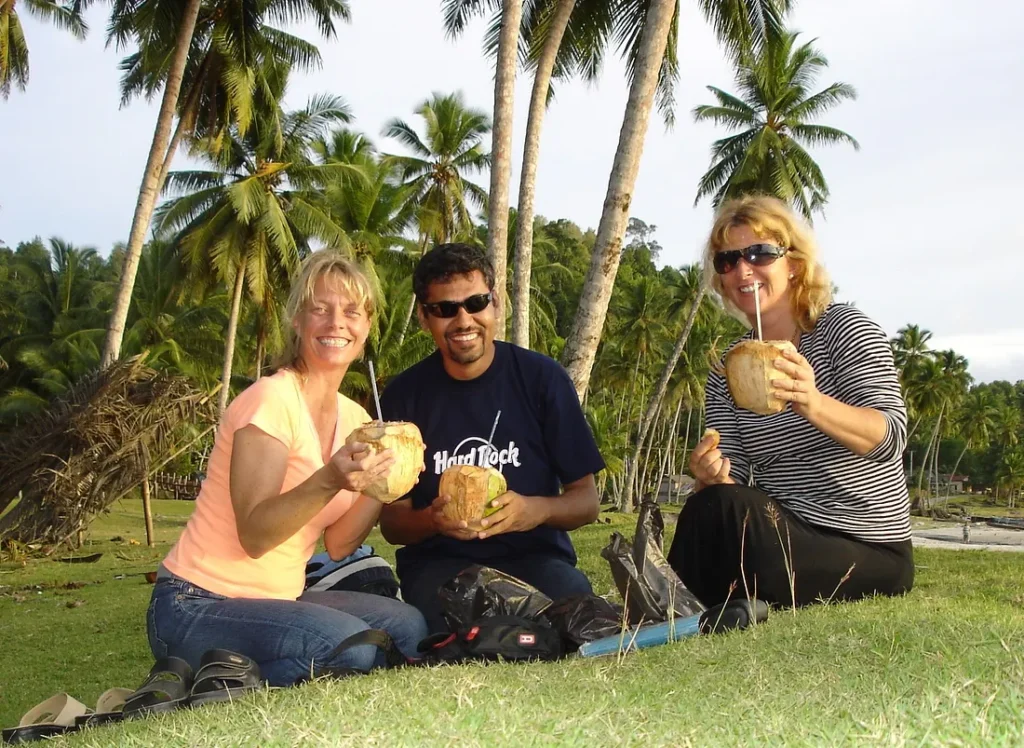
They called it a “welcome tour.” I called it a sneak preview of my impending mental breakdown. My first one-week mission to Simeulue was supposedly to “get briefed” on the projects I’d be handling — but let’s be honest, it was really just an orientation to chaos, remote island-style. Nothing says warm island hospitality like mud roads, collapsed bridges, and a to-do list that reads like a survival challenge.
Little did I know, I was being gently escorted into the heart of an engineering twilight zone — complete with fake contractors, mystery consultants, and enough nonsense to make a grown man cry into his site plan.
And so the tour began.
Anne Signe, the Norwegian Red Cross WatSan Adviser, had also landed on the island around the same time, and together we set off toward Sibigo (Baturagi) — a tiny village tucked at the farthest edge of the island. A short 3–4 hour journey, they said. But they forgot to mention the part about dodging potholes the size of swimming pools and crossing bridges so broken they had already claimed a chunk of the tsunami recovery funds — without even trying to hide it.
One year after the “rehabilitation,” most of these bridges had either collapsed, cracked, or — my personal favorite — vanished completely. So now, crossing rivers was back to the Stone Age, with communities throwing logs across the gap and driving cars over them like they were reenacting an episode of “Survivor: Simeulue.”
The process went like this: We’d arrive at a bridge (or what used to be one), and our driver, Pak-No, would order us out of the car. He would then heroically volunteer to drive the Toyota Land Cruiser across the timbers, perfectly following the narrow planks — because one centimeter off and the car would slide into the river like a drunk seal. We, of course, got to cross on foot, pretending we were in some adventurous travel documentary, while in reality, we were just the unwilling extras in a poorly planned sequel.
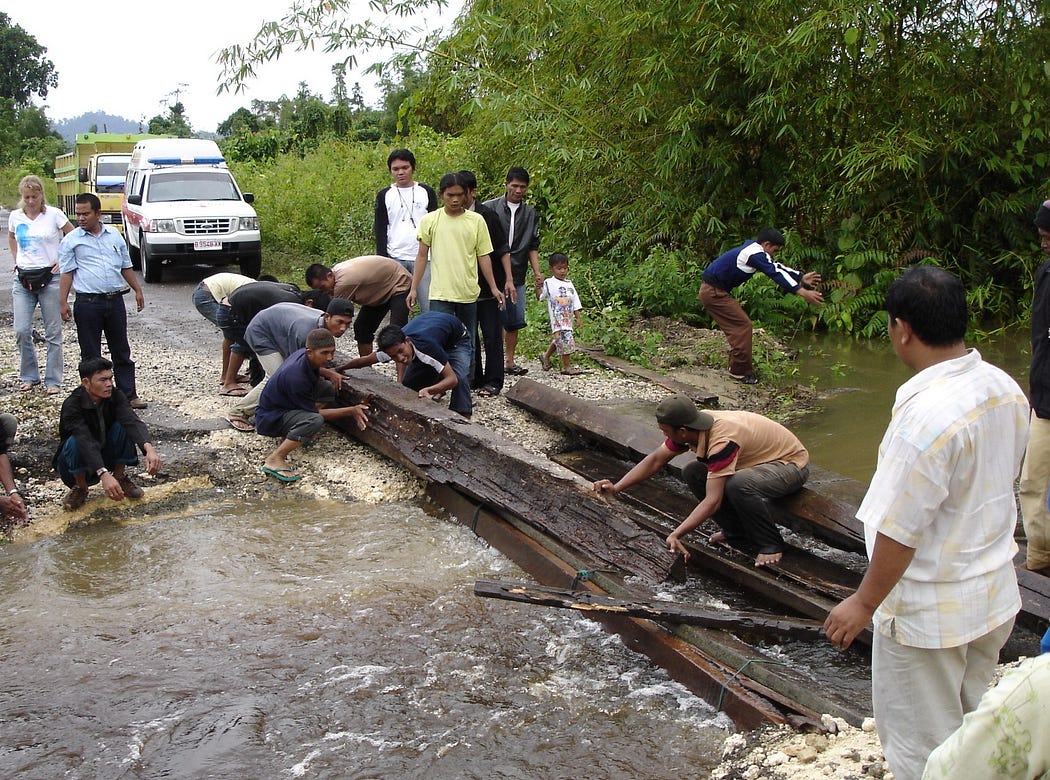
This “bridge gymnastics” was repeated several times. And then there were the roads. In the rainy season, the mud would swallow half the car. Thank heavens for Japanese engineering — those 4WD Toyota LCs could plow through mud like sushi through soy sauce.
After several hours, we finally reached Baturagi village — home to the Norwegian Red Cross’s ambitious infrastructure projects: a half-million-liter water reservoir on the hill, a two-story market building big enough for a small city, a 25-kilometer PE piped water network, and community WatSan facilities in 20 villages. On top of that, we had livelihood projects for women (microfinance, small business ventures) led by Erna, and CBHFA — Community-Based Health and First Aid — health and hygiene promotion led by Kirsti.
But before diving into the juicy details of my future headaches, let me give you a snapshot of Baturagi in 2007.
Walking into Baturagi felt like stepping into a postcard titled Basic Survival: The Minimalist Edition. The population was no more than a few hundred — mostly fishermen or coconut/sago gatherers. Infrastructure? Forget it. No paved roads, patchy electricity, and zero formal water systems. Social life revolved around fishing seasons, smong (tsunami) warnings, and the occasional weekly village gathering.
The fishing routine was a masterpiece of “just enough” economics: head to the ocean, catch one or two fish — enough for dinner — and then spend the rest of the day sitting in front of the house, watching for passing cars (which was basically once every blue moon) or… well, just sitting. The concept of catching more fish to sell? Absolutely not. Who would buy it? Everyone else already had a fishing rod, and without proper infrastructure, cold storage, or transport, the only place that fish could go was… right back into the sea, metaphorically speaking.
Anything that’s built as public infrastructure needs maintenance — and in Baturagi, that concept was as foreign as a Starbucks franchise. Not just because of the cost, but because of the way of life here. Why complicate life?
Water? Comes from a spring or a hand-dug well.
Fish? From the ocean.
Rice? You grow it.
That’s it. That’s the survival starter pack. You don’t need anything more — no manuals, no user fees, no monthly maintenance schedules.
In short: It was basic. Tiny. So far from everything that you could stand in the middle of the village and see the edge of the known universe. Just fishermen, a few gardens, and the occasional rumor that an NGO truck had been spotted somewhere. Exactly the kind of place where a fake contractor with zero experience could vanish — a land of concrete nightmares waiting to be born.
Welcome to Baturagi.
Welcome to my mission.
Logically? Absolutely not.
But in the bizarre world of post-tsunami humanitarian reconstruction? Of course it did. Because money had to go somewhere.
Let’s talk about huge Viking ambitions — and let’s start with the first masterpiece: the two-story market building in Baturagi.
For what?
This wasn’t exactly downtown Jakarta. The entire population was maybe 500 people, most of them fisherfolk who only sold fish occasionally — and usually to people who didn’t want to fish themselves. There was no bustling trade, no fruit stalls, no vegetable carts. If you wanted rambutan or durian, you just walked into the forest and picked it.
The only consistent “customer” was us — and even then, we were mostly buying ikan kayu (that rock-hard fish you could use as a building material if you ran out of bricks).
So who, exactly, was this two-story monument to economic fantasy for?
Apparently, for the aerial photos in donor reports. Because nothing says “We saved the village” like a massive, empty market where goats hold more board meetings than humans. 🐐
Now we come to the next grand Viking ambition — a half-million-liter water tank for a village like Baturagi, paired with a 25 km piped water network.
Looks amazing on a glossy donor proposal. In reality?
Every single house had no internal plumbing, no taps, and zero plans to install either. The terrain was so rough that laying 25 km of pipe meant hacking through solid limestone, then backfilling it with sand hauled from who-knows-where — because nothing says “sustainable” like spending a fortune to bury pipes no one will ever maintain.
Maintenance? Forget it. The first time a pipe broke, it would be “fixed” with a bit of old cloth, some wire, and a prayer. And the tank itself? A half-million-liter reinforced concrete giant perched on a hill — for a tiny village. That’s like building an Olympic swimming pool in the middle of a goat farm.
Best-case scenario: it evaporates slowly under the sun.
Worst-case scenario: the next earthquake cracks it open, and the entire thing turns into a flash flood, washing goats, chickens, and possibly the market building straight into the sea.
And finally — the pièce de résistance of misplaced development dreams: Community Toilets and Showers.
Let’s be honest.
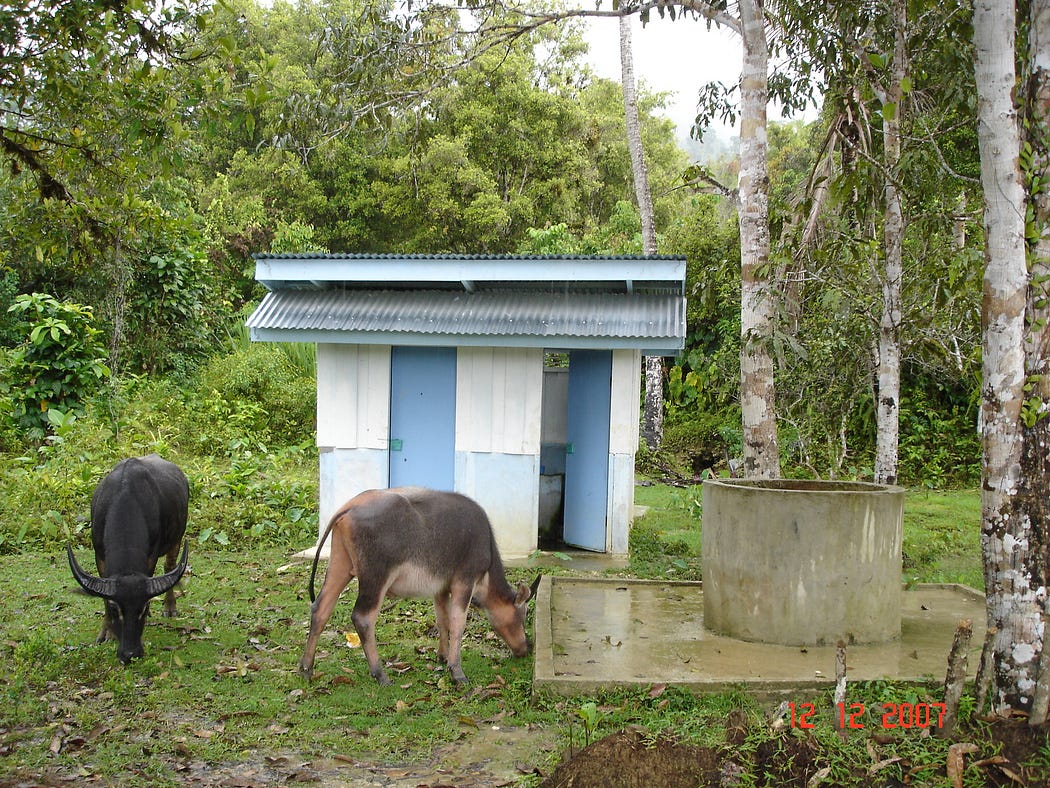
Cultural norms, daily habits, and plain common sense meant that villagers preferred the original “five-star” facilities: the river, the sea, or the forest. Why walk to a public block when you can enjoy an open-air bathroom with a view, no queue, and no awkward encounters with your neighbor?
The brand-new toilet blocks, built with love (and a hefty budget), quickly found their true purpose:
· 🐐 Goat hotels — fully booked during rainy season.
· 🐓 Chicken rest stops — great for laying eggs in privacy.
Get SHIR SHAH AYOBI’s stories in your inbox
Join Medium for free to get updates from this writer.Subscribe
· 👻 Occasional ghost houses — for anyone brave (or foolish) enough to open the creaky door at night.
Basically, the only human beings ever seen inside were NGO delegation members posing for the obligatory “community sanitation success” photo — before discreetly heading back to their guesthouse bathrooms.
So why was it planned to be built?
Because:
Donors love big, shiny, visible things. Market buildings and giant water tanks look amazing in aerial photos and year-end reports. No one wants to fund “training local technicians to fix broken PE pipes” — but a two-story market? Boom! Instant Project Success™!
And then there’s the classic “use it or lose it” funding syndrome — money had to be spent before deadlines, so logic and sustainability were politely shown the door.
The result? Baturagi got an oversized buffet of infrastructure it didn’t need, couldn’t maintain, and barely used — while real priorities like boat repair workshops, small-scale fish storage, or vocational training were lost somewhere between the proposal and reality.
But hey… at least the goats got flushing toilets. 🐐🚽
Now, let’s get to the briefing with Anne Signe…
Anne Signe was kind, smart, and a solid professional WASH specialist — the kind you actually want advising from HQ. From the moment I met her, I could tell she was someone who would understand me: a younger, stubborn, Red Cross values addict with a low tolerance for nonsense and a dangerous obsession with quality work.
I could already smell the challenges ahead — and let me tell you, they smelled suspiciously like fraud and concrete dust.
At this point, the community WATSAN units were halfway done, and the water reservoir and 25 km water network hadn’t even started. But before I arrived, a contract had already been signed with a group calling themselves CV Nabila — supposedly a contractor.
In reality? CV Nabila was about as much a contractor as I am a K-pop idol. No tools. No machinery. No office. Nothing. Just a name, a smile, and a contract they had no business holding — all thanks to a few “helpful” corrupt consultants (middlemen) and a high-level decision-maker in the Aceh office who signed the deal without following any IFRC procurement procedures.
And here’s the extra twist — that giant, two-floor market building? At this point, it wasn’t even my responsibility. The higher up, in a moment of pure strategic genius, gave the responsibility for construction works to… wait for it… the livelihood delegate.
Yes, Erna. Lovely, hardworking Erna — who knew absolutely nothing about construction. Meanwhile, me — the civil engineer — was politely kept out of it.
Makes perfect sense, right?
Because why let an engineer handle construction work when you can assign it to someone you can easily trick?
Now, if I were the one supervising, I’d be an absolute menace to every bad contractor and slippery middleman. I’d even be a chronic headache for the Banda Aceh bosses. I’d question every delivery, every mix ratio, and every mysteriously disappearing bag of cement.
So, to keep the peace and avoid elevated blood pressure across the province, better to assign the supervision to the anthropologist. To be fair, she’s smart — definitely sharp enough to sense when something’s not right — but let’s just say she wasn’t exactly trained to tell the difference between a T10 rebar and a poorly bent tie wire. and she definitely won’t notice whether the sand came from the beach or from a proper gravel supplier. Ignorance is bliss… and in this case, also a construction strategy.
We continued our visits to a couple of WATSAN units in the communities. On paper? They looked fancy — shiny tiles, shiny taps, a monument to “progress.”
For the communities? Zero sense.
Why? Because when you’ve got an entire coastline, the ocean, and a forest as your personal open-air bathroom, why on earth would you queue up to use a hot, stuffy public cubicle in the middle of nowhere? Nature is free, spacious, and doesn’t require a key.
And showers? Same logic. Who wants to walk to a public room just to splash around in a dribble of cold water when you can jump into the sea or rinse off in a river like your grandparents did?
But the project had to continue… because “donor deliverables” don’t care about cultural habits.
I kept my mouth shut. At this point, I wasn’t even officially starting my mission — this was my probationary period. And if there’s one thing you don’t do on probation, it’s insult the pet projects of someone high up in Aceh. Instant firing material.
Then we went uphill to visit the reservoir site.
Anne Signe frowned.
“If an earthquake hits again and this reservoir bursts, half a million liters will come crashing down into the village. What will happen?”
I wasn’t too worried — in theory, a properly built reservoir shouldn’t break.
But then again, Anne probably already had a sixth sense for the kind of “quality” CV Nabila was about to deliver.
And speaking of the village —
It looked simple. Life looked simple.
And for a fleeting moment, I thought, Yeah… I could be happy here.
What I didn’t know was that, in just a few weeks, I’d be knee-deep in mud — both literally and politically — trying to mediate between a fake contractor, a “consultant” who conveniently helped award the contract to said contractor and was now being a little too friendly to risk raising any complaints, all in the name of keeping things “peaceful.” Makes perfect sense, right?
Meanwhile, the bosses were already sharpening their pencils, preparing to write “delayed progress” with my name featured prominently on every page.
Turns out, saying no to substandard work makes you very unpopular in circles where cutting corners is practically a hobby.
The visit was complete.
I was ready to return to Kabul, hand over my ICRC job to the new delegates, and come back to Simeulue to start my “adventure.”
Little did I know, this wouldn’t just be an adventure — it was going to be the Battle of Baturagi: Me vs. The Contractor, The Consultant, and The Rest of the Universe.