
And so, the next stroke of genius from the higher-ups landed squarely in my lap.
“We need you in Panjshir Valley to rehabilitate hospitals there.”
Lovely.
Picture this: I was already knee-deep in the chaos of Sarpoza Prison, working under the suspicious glares of guards who would have loved to slap a “spy” label on me for simply existing. And now, I was being ordered to split my time between Kandahar and Panjshir — enemy territory.
Not just any place — a Northern Alliance stronghold. Essentially, the polar opposite of Kandahar, but with the added bonus of regular air raids.
“Isn’t this a bit insane?” I asked.
The higher-ups just smiled, the same way a parent smiles when handing a toddler a plate of broccoli and saying, “You’ll love it.” Their actual answer?
“You can handle it.”
Translation: “You’re too stubborn to say no.”
Working in Kandahar was already like juggling flaming knives over a shark tank. But Panjshir? Oh no. That was the advanced level, where they added a blindfold and tied your hands behind your back.
Securing permission and trust from both factions — two groups who hated each other with Shakespearean levels of passion — was like trying to broker peace between two toddlers fighting over the last cookie. One wrong word, one innocent misunderstanding, and suddenly I’d be wearing a shiny new label: traitor.
Why me? Simple. I was the guy who never said no.
Give me the most impossible, soul-crushing assignment, and my response was always:
“Sure. Why not?”
Dangerous mindset? Absolutely.
But it had gotten me this far, and I was too stubborn to change.
Panjshir in 1999 was not a vacation destination.
Mountains upon mountains, a sprinkle of landmines, a side of starvation, and a generous serving of Taliban blockades. Every entrance to the valley was either a Taliban checkpoint or a warzone.
You could get in by horse, mule, or prayer.
Basically, I was signing up for mission impossible — but with fewer supplies than a scout troop’s camping trip.
When I first got the news, my family was thrilled. “You’re going WHERE?!”
My uncle practically threw himself in front of the door.
“If you’re going because of the salary, STAY! I’ll pay you the same amount. It’s not worth it!”
I smiled.
“Uncle, it’s not about money. It’s the challenge.”
Translation: “I’m being my usual stubborn self.”
“Do you know how dangerous it is?!” he continued, “They might arrest you. Or worse!”
But I was set on it. This was what I did.
The office instructions?
First, travel to Kabul. Then take a Red Cross plane to Faizabad in Badakhshan. From there, it’ll be a mix of Land Cruiser, horse, and hiking over snow-covered mountains for three nights and four days.
“Sounds like a dream vacation!” I said with a grin.
Reality:
The “roads” (if you could call them that) would be landslide-prone, bridge-less, and snow-covered — even in summer.
Nights in the mountains would be bone-chilling, and tents didn’t exactly come with central heating.
Wild animals? Let’s not think about it. But I was ready.
Adventure or disaster — it was all the same to me. Bring on the mountain lions and warlords. Let’s go.
The trip started in Kabul, where three of us squeezed into a tiny Red Cross plane — brand new, but so small with a maximum capacity of just nine people, it was less of an aircraft and more of a flying minibus with wings. The destination? Faizabad.
The airstrip? Not what you’d call a “proper” runway.
It was a patchwork of metal panels awkwardly laid between towering mountains.
Landing there required the skills of a seasoned pilot.
Or, in our case, someone with a death wish.
Once we miraculously touched down, the real adventure began.
The route through the Anjuman Pass (elevation: 6,000 meters!) was not just a road — it was a cruel, winding path designed by Mother Nature to weed out the weak.
Cars could only take us so far before we had to switch to more reliable means of transport — horses, donkeys, and our own two feet, clinging to narrow trails where one misstep meant a dramatic and very permanent descent.
As we climbed higher, the air grew thinner and colder.
Breathing felt like trying to sip soup through a straw — while someone punches you in the lungs.
For a guy coming from Jalalabad’s comfortable 600-meter altitude, this was like suddenly moving to the top of Mount Everest without training.
And sleeping? Oh, that was a nightmare.
Imagine trying to doze off in a flimsy tent with winds howling around you like angry spirits, temperatures plunging below freezing, and only a military-style ration pack to keep you company.
If you’ve never tried to warm yourself with a packet of stale biscuits, let me tell you — it doesn’t work.
Our gourmet options included:
✔ Rock-hard, vacuum-packed rice that even mountain goats would refuse.
✔ Dry biscuits that turned to dust on first contact with your mouth.
✔ Canned sardines, because why not add a touch of suffering to an already miserable meal?
Hunger was the least of our problems, though.
Avalanches? Always looming.
Slipping off the edge? A real possibility.
And let’s not forget altitude sickness, which made every step feel like dragging a sack of bricks uphill.
After three days of this madness, we finally descended into Panjshir Valley.
Where — surprise! — the challenges took a different form.
Welcome to Panjshir: Where Everyone Thinks You’re a Spy
Now, let’s talk about the warm welcome I received.
Being a Pashtun from Jalalabad in Northern Alliance-controlled territory was basically like showing up to a police station with a ski mask and a bag labeled “Not Stolen Money.”
The fact that I had previously worked in Taliban-controlled Kandahar (Sarpoza Prison, no less) didn’t help my case.
Every checkpoint was an interrogation session.
The Red Cross logo on my jacket?
A slight buffer, but no guarantee of safety.
I needed diplomacy, patience, and nerves of steel to get through each encounter without getting accidentally arrested or worse.
After my thrilling “Am I a Spy?” interviews at every checkpoint, I finally arrived in Astana — which, by the way, is NOT a town.
It’s a scattered cluster of houses perched on a mountain like someone randomly sprinkled homes from a great height.
And the Red Cross office?
It was on the very edge of a cliff, a perfect spot if you wanted a constant reminder that one slip could turn you into a human snowball rolling into the Panjshir River below.
The Red Cross office in Panjshir was tiny, barely holding together, with just a handful of staff members trying to perform miracles with nothing but sheer willpower. At the helm of this circus was Hans Peter, a Swiss-German who led the delegation with the patience of a monk and the no-nonsense attitude of a drill sergeant. He wasn’t the type for small talk, and certainly not the type for sugarcoating things.
And so began my Panjshir survival saga — where every day was a battle against altitude, cold, suspicion, and food so terrible it made military rations look like fine dining. The mountains were breathtaking, but everything else? A living nightmare.
Morning came, and with it, my official job briefing — or rather, my baptism by fire.
Hans Peter sat us down for breakfast, which consisted of stale bread and something resembling tea. Across from me sat two other colleagues — one, an agronomist from the same province but of Pashtun descent, which in this part of the country was an automatic “Taliban sympathizer” label. The second, Wasey, a first-aid practitioner who had spent years in the Red Cross as an ambulance worker, also a Pashtun. In other words, in Northern Alliance-controlled Panjshir, we might as well have been a delegation of suspicious characters waiting to be deported.
Hans Peter laid out the mission. On paper, it sounded simple. The agronomist would train farmers, assess land conditions, and eventually distribute agricultural supplies — if the Red Cross managed to smuggle them in from Kabul, Tajikistan, or the land of miracles. Wasey, the health guy, would teach communities about hygiene and, if supplies ever arrived, distribute basic medical kits to clinics — if we found clinics that still had walls.
Hans Peter turned to me with the kind of look you give someone right before handing them a live grenade and saying, ‘Catch!’
“You, my friend, have the construction work,” he said. “There are three hospitals — well, technically, three places where hospitals used to exist, at least that’s what the health authorities tell me. I’m not a technical person, but…”
And then came the horror story.
Apparently, one hospital was “partially functioning,” which, knowing my luck, meant it probably had half a bed and a doorframe. Another was “damaged,” which could mean anything from missing a few windows to looking like it had been personally stomped on by Godzilla. And then, the grand prize — one that was so far gone it might as well have been a historical ruin. If anyone got injured there, their best shot at survival was thoughts and prayers.
I blinked. This was a joke, right? Nope.
Hans Peter handed me the key to the Land Cruiser with the same solemnity as a medieval knight bestowing a sword upon a doomed soldier.
“This is your vehicle,” he said. “And that’s the cashier’s office. I can’t help you more than that. You’re on your own.”
Fantastic.
My brilliant response? “Okay.”
Was this enthusiasm or blind stupidity? Hard to tell. But in my six years of experience as a young civil engineer, I had one golden rule: Never say no.
The First Challenge: Driving on the Edge of Death
Before I could even begin assessing the ruins — ahem, hospitals — there was the small issue of getting the car down the mountain.
Let me set the scene.
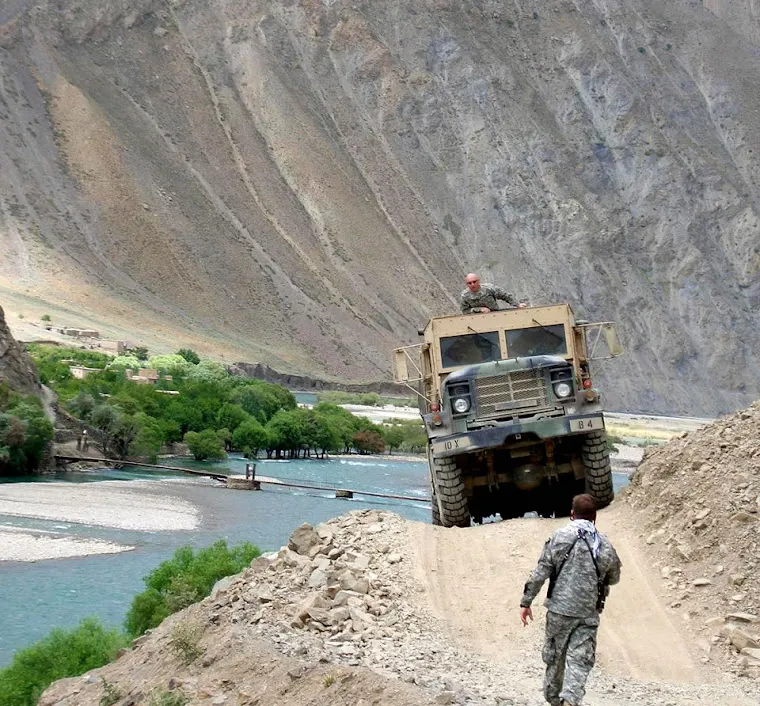
A single-lane dirt road, barely wide enough for one vehicle.
On one side? A sheer mountain wall, ready to scrape off your car’s paint — or your face.
On the other side? A vertical drop into the icy, unforgiving Panjshir River.
Oh, and one small detail: you couldn’t drive forward.
To get down, you had to reverse your way down the twisting mountain path, because if you tried to go forward, you’d be heading in the opposite direction — which meant driving 15 kilometers before finding a spot to make a U-turn.
And if a military truck came toward you? Good luck, my friend. You’d be reversing for kilometers, hoping your ancestors had a good afterlife planned for you.
The Red Cross staff gathered to watch — probably placing bets on whether I’d make it down in one piece or become the newest addition to the river’s casualty list.
I took a deep breath. I had pulled tankers before while constructing clinics in IDP camps. This was just another day in the office.
I asked the guard to come with me (because navigating a war-torn valley alone seemed like a particularly bad idea), got Hans Peter’s blessing, and we set off.
The first stop was Changaram Hospital, the smallest of the three. If anyone had forgotten what war looked like, this building was a perfect reminder.
The hospital was an absolute wreck. No doors, no windows, no beds, no medical equipment. Forget the operating room — there was barely a standing wall left.
The only sign that this place used to be a hospital was an old, half-broken sign with faded writing that had seen better days.
The question now was: who the hell used to work here?
After a long search, I found the maintenance guy. Not a doctor, not a nurse — the guy who used to take care of the water system and generator.
Well, good enough for me.
Congratulations, my friend — you’re now my assistant.
With one swift recruitment move, I had someone to help supervise workers, masons, carpenters, and laborers — all of whom I still had to find, train, and convince that they wouldn’t die rebuilding a hospital.
Moving on…
Next stop: Rokha Hospital.
It still had walls and a roof, which was already a luxury upgrade from the first one. But nothing worked. Power? Nope. Water? Not even a drop. The place had more damage than functionality, but compared to Changaram, it was practically a five-star facility.
And finally, we drove farther down the valley to Gulbahar Hospital.
This was the big one — a 52-bed facility. Partially functioning, which in warzone language meant barely surviving. It still had some beds, but no power, no water, and most of the medical equipment was broken.
Standing there, looking at these so-called hospitals, I had one burning question in my mind:
Did I really just sign up for this?
I wasn’t here to just throw some bricks around and patch a few walls. I needed beds, mattresses, sheets, electricians, plumbers, carpenters, painters — basically, an army of workers and a miracle.
And knowing myself, I wasn’t going to settle for half-baked reconstruction. If I was doing this, I was going to do it right.
Time to get to work.
Driving back and forth between the hospitals and the Red Cross base, I quickly realized that the term “road” was wildly optimistic.
What we had was a narrow, winding death trap, barely clinging to the mountainside, with the Panjshir River roaring below like it was waiting for its next victim.
It wasn’t just the usual potholes or bumps. Landslides were a casual event, and rockfalls could turn a smooth ride into a survival challenge within seconds. And just when you thought you’d mastered the art of dodging falling boulders, you’d hit the next level of frustration: military checkpoints.
Every few kilometers, a group of suspicious, heavily armed soldiers would stop me, inspect the car as if I were smuggling Taliban gold bars, and ask the same predictable, exhausting questions:
“Who are you?”
“Where are you going?”
“What’s in the car?”
“Are you a spy?”
Ah yes, because spies drive around in a Red Cross vehicle with a giant, visible logo.
By the end of the day, my new routine was clear.
Spend the entire day inspecting ruins that used to be hospitals.
Wonder how I was supposed to rebuild them without materials, workers, or even a functioning hardware store.
Return to base, covered in dust, looking like a survivor of an apocalypse.
That evening, as I drove back to the base — which doubled as both the office and our residence — my mind was racing with one simple question:
How the hell am I supposed to do this without supplies?
There were no hardware stores. No markets for construction materials. Not even a shady guy selling overpriced cement in a back alley. The valley had nothing.
But before I could spiral further into my logistical nightmare, dinner took a dramatic turn.
Disaster, and Deportation
Hans Peter, our Swiss-German head of delegation, was not a man of unnecessary words. So when he made an announcement, you knew it was serious.
“We have received a letter from Ahmad Shah Massoud’s office,” he said. “One of our visitors must leave immediately and return to Kabul.”
Well. That killed my appetite.
Three of us had arrived yesterday — me, Wasey (the first-aid guy), and the agronomist. One of us was about to be exiled.
Now, logically, I should have been the prime suspect.
I had just come from Kandahar — aka Taliban Central.
I was Pashtun, which made me automatically suspicious in Northern Alliance territory.
I was an engineer, and if you had no idea what an engineer actually did, it was very easy to assume I was a Taliban explosives expert.
But no. Hans Peter continued, “Unfortunately, we must evacuate our agronomist.”
Oh. Not me. Well, that’s a relief.
The poor agronomist, who had just arrived yesterday and was supposed to help farmers, was now being kicked out before he could even plant a single seed.
The official reason? He was accused of being a Taliban spy.
The real reason? He was Pashtun, and someone with political paranoia had decided he was a threat.
No appeals. No second chances. He was going back.
Now, you might think, Well, at least he could be back in Kabul in a few hours.
Wrong.
Sure, Kabul was just 80 kilometers away — an hour’s drive on a normal road. But this was Panjshir in 1999, and the direct route was an active war zone, full of landmines, front lines, and a guaranteed death wish.
So instead, he had to take the scenic route.
Trek over the 6,000-meter Anjuman Pass — again. Survive the treacherous journey to Faizabad. Find a ride (or a miracle) to Tajikistan or another Red Cross route to Kabul. Finally reach Kabul. A five-day journey for an 80-kilometer trip.
We saw him off the next morning, wishing him luck as he embarked on his unexpected exile.
And just like that, one of us was gone.
With the agronomist kicked out, there were only two of us left — me and Wasey.
If Massoud’s office was going to keep randomly deporting Pashtuns, we might not even make it to next week.
Hans Peter didn’t look happy. I could see the concern in his face as he sipped his tea, watching the tension slowly build.
Meanwhile, I had my own nightmare to deal with — how to build hospitals without construction materials.
Get SHIR SHAH AYOBI’s stories in your inbox
Join Medium for free to get updates from this writer.Subscribe
After checking out the local shopping scene (which consisted of a few tiny shops selling basic groceries and not much else), it was painfully clear: if I needed cement, steel, or wood, I had to become a magician.
Cement? Pray for a miracle shipment.
Wood? Hope the roads weren’t blocked.
Electric cables? Might as well have asked for a spaceship.
Everything was either delayed, scarce, or required creative solutions that bordered on madness.
And then there was the human factor.
Everywhere I went, locals looked at me with suspicion. It was as if they thought I had arrived with a secret mission to steal their last remaining bricks.
Trust? Didn’t exist. Resources? Nowhere to be found. Time? Running out.
I had to negotiate, improvise, and outlast every possible obstacle. Because at the end of the day, no one cared how impossible the job was. The hospitals had to be rebuilt.
And somehow, I was going to do it.
If I thought my days in Panjshir were already teetering on the edge of insanity, today proved me wrong.
The nearest “big” town where I could possibly find construction materials was Charikar, a mere 60 km away. But in 1999 Afghanistan, 60 km wasn’t just a drive — it was an extreme sport.
To even attempt this journey, I needed:
A death wish. A vehicle that could survive a warzone. Luck. Lots and lots of luck.
The route to Charikar was a delightful mix of military-grade insanity and sheer stupidity.
Halfway to Charikar, the road passed through Jabal Saraj, an area where Taliban snipers and rocket launchers enjoyed their favorite pastime: blowing up Northern Alliance vehicles.
My survival strategy?
Drive at least 120 km/h. Yes, on a dirt road littered with bomb craters, mines, and general destruction.
Pray. A lot.
Hope my Red Cross logo made me look like a humanitarian, not a target. Taliban fighters weren’t exactly known for strictly following the Geneva Conventions.
A portion of the road used to be a frontline. In a brilliant tactical move, the Northern Alliance had planted anti-tank mines when they lost the area. When they won it back, they realized they had lost the minefield maps.
Result? Four missing anti-tank mines.
No problem, right? There was a safe way through: Drive only on the tire tracks left by previous vehicles.
Small issue: There were hundreds of tire tracks. Some led straight to disaster.
The road turned to mud during winter, making it even harder to tell which were safe.
One wrong move and — boom. Instant fireworks.
If I miraculously made it to Charikar alive, I had exactly five minutes to buy what I needed before Taliban spotters on the hills rained mortars and rockets down on us.
Find the shopkeeper. Hope the shop was still standing.
Hope the shopkeeper remembered he even HAD supplies.
Throw everything in the car. Get out before becoming a statistic.
Now, repeat this process multiple times because no single shop had enough supplies to be useful.
As if this wasn’t enough, I needed shopkeepers to actually come with me to Charikar to get their stock. Basically, it was recruiting Shopkeepers for a Suicide Mission
Did they want to take this insane risk? Of course not.
Did they have a choice? Well… neither did I.
I hunted down anyone still brave — or desperate — enough to have a shop in Charikar that still had nails, glue, oil paint, or anything remotely useful.
Most of them weren’t thrilled about my “Mission: Certain Death” plan. But, in the end, they agreed.
Whether out of bravery, stupidity, or just lack of better options, I now had my reluctant team of shopkeepers.
Now all we had to do was survive the drive, avoid being blown up, collect supplies, and make it back in one piece.
Simple, right?
Dinner Time: Another Episode of “Who Gets Deported Next?”
Back at the base, I made it just in time for dinner, exhausted but mentally prepared for another Hans Peter Surprise Announcement.
Would it be: A new assistant for me? A driver? A secret stockpile of construction materials smuggled from Tajikistan?
Of course not. That would have been too logical.
Instead, Hans Peter dropped another bombshell.
“Unfortunately, we have to deport another colleague of ours.”
Dead silence.
Great. Here we go again.
This time, the unlucky winner of the Panjshir Deportation Lottery was Wasey, the health officer.
The accusation? “Sympathizing with the Taliban.”
His crime? Being Pashtun and existing in Northern Alliance territory.
And just like that, we had to evacuate him the next morning.
One more out.
And guess who was the only one left?
Me.
At least next time Hans Peter made an announcement, I wouldn’t have to guess who was getting kicked out.
Let’s face it: I wasn’t exactly in the clear.
I had worked in Taliban-controlled Kandahar. I was Pashtun. I was from Jalalabad — a city associated with the South. I was basically a walking red flag.
To the Northern Alliance, this made me the perfect “Taliban Spy Candidate.”
Every move I made was watched. Every word I spoke was analyzed, dissected, and doubted. Every person I talked to? Potentially reporting back to the authorities.
One wrong step, and I wouldn’t just be deported — I’d be detained.
Hans Peter’s Morning Panic Attack
The next morning at breakfast, Hans Peter looked… uneasy.
He took a deep breath and spoke.
“I’m very much worried about you. What happens if we lose you too?”
I smiled. “Don’t worry, they won’t deport me.”
Hans Peter frowned. “How can you be so sure?”
Simple. Massoud’s office didn’t know who was coming and going.
They weren’t running full-scale investigations in two days. Someone in our own office was leaking information.
“Since day one,” I continued, “I’ve followed the Red Cross principles. I don’t take sides. I’m impartial and independent. And they know it.”
Hans Peter still looked doubtful. But me? I was confident.
Why? Because if they wanted to deport me, they would have done it already.
Every morning, before the sun had even fully convinced itself to rise, I was already in the driver’s seat of my Red Cross vehicle, heading off on another wild adventure in hospital resurrection.
By 5 AM, I was on the road, weaving my way through a landscape that seemed to be actively trying to kill me — rockslides, landmines, military checkpoints, and of course, the occasional rocket fired by Taliban fighters who clearly had nothing better to do.
But today, I had a strategy.
Forget about tackling all three hospitals at once. That was a one-way ticket to a mental breakdown.
I needed to start with the smallest hospital first.
Was there an “easy” one? Not really.
But relatively speaking, the Changaram Hospital — with its 18-bed capacity and a foundation that at least still existed — seemed like the best bet.
The actual construction work wasn’t the hardest part.
Finding masonry workers and carpenters in Panjshir was doable.
But fixing the electrical system, the generator, the X-ray machine, the autoclave machine?
That was a different beast altogether.
It wasn’t like I had a team of specialists waiting on standby.
But thanks to my experience in Jalalabad, my background in engineering, and probably sheer luck, I somehow managed to repair them all.
To this day, I still don’t fully know how I pulled it off.
Maybe some knowledge from my high school days studying high-voltage electricity kicked in.
Maybe it was my university training in civil engineering.
Or maybe, the universe just decided to give me a break.
Either way, those machines turned back on.
And with that, Changaram Hospital was officially rising from the dead.
Beds? Made from salvaged timber.
Sheets? Found massive rolls of linen from an old textile factory warehouse that somehow hadn’t been looted.
Operating room gowns, patient pajamas? Sewn from that same linen.
Somehow, I was making progress.
But materials were still a nightmare.
I was still hunting for shopkeepers who had stashed construction supplies somewhere in the valley.
Some had brought their inventory to IDP camps.
For the rest, I had to personally take them to Charikar — through rocket-fire territory — and convince them to retrieve whatever stock was left.
Charikar trips were a game of speed.
Drive in. Shop like your life depended on it (because it did).
Grab whatever looked remotely useful.
Speed back out before Taliban spotters launched mortars.
Most nights, I got back after 9 PM.
Hans Peter wasn’t pleased.
“Why are you coming back so late?” he asked, arms crossed, frustration clear. “Red Cross vehicles should not be driving after dark. It’s a security risk!”
I sighed.
“Do I have a choice?”
The hospitals weren’t going to fix themselves.
If I followed every security rule to the letter, nothing would ever get done.
I quickly came to the life-altering realization that splitting my time 50% in Kandahar and 50% in Panjshir was about as practical as juggling chainsaws while blindfolded. It was a brilliant strategy — if my ultimate career goal was to turn into a human popsicle in one place and a bullet magnet in the other.
And then there was winter. A real, unforgiving, no-one-is-going-anywhere kind of winter. The kind that doesn’t just politely block roads — it swallows them whole. Every route out of Panjshir was buried under so much snow that even the most stubborn donkeys had staged a protest. Horses? Forget it. Even the most suicidal traveler wouldn’t attempt it on foot. Panjshir had officially become a frozen prison.
I called the boss and proposed the only logical survival strategy: “Look, I’m stuck. I might as well finish the job here. Send another engineer to Kandahar before Sarpoza Prison drowns in a biblical flood of sewage and turns into the world’s first open-air cesspool.
The boss agreed immediately. Or, more likely, he just didn’t have a better plan and had run out of options. Either way, I wasn’t complaining.
So, I stayed in Panjshir, fully committed to hospital rehabilitation, with a peaceful mind.
Well, not really peaceful, but at least I wasn’t losing sleep over whatever nightmare awaited me in Kandahar’s Sarpoza Prison. And in the grand scheme of things, that was already a victory.
In an average day, I was driving at least 150 km, dodging checkpoints, mines, and rockets, all while convincing people to help me rebuild a place they had long given up on.
And then there was the human factor. There were workers available.
But they weren’t working to my standard. I had to train them.
Masons, electricians, carpenters — they needed to learn exactly how I wanted things done.
At the end of the day, I wasn’t just rebuilding hospitals.
I was building a workforce. One that could continue long after I was gone.
After five months of chaos, stress, and sheer determination, the smallest hospital was finally complete.
More than 70% of Rokha Hospital was finished, and work had officially begun on Gulbahar.
But Gulbahar had even bigger challenges. No water system.
That meant designing a way to bring water from the river, building a pumping station, and constructing an elevated water reservoir.
I wasn’t going to let this project fail.
Because by now, I had spent so much time in Panjshir that this wasn’t just a mission anymore.
It was personal. And I wasn’t leaving until it was done.
By the time spring arrived, I had officially spent nine months in Panjshir. Winter had made travel through Anjuman Pass impossible, meaning I had no choice but to stay and finish the job.
But by now, something had changed.
All three hospitals were finally completed. Beds? Installed. Medical equipment? Functional. Water and electricity? Running. Patients? Finally being admitted.
Looking back, I realized something: I arrived as an outsider. I survived as a suspected spy. I left as the guy who rebuilt their hospitals.
Even the local authorities, once suspicious of my every move, had come to respect my work. They finally understood I wasn’t there for politics. I wasn’t there to take sides.
I was just there to fix their damn hospitals.
And in the end, that was enough.
For nine months, I had no direct contact with my family in Jalalabad.
The only way to get updates? A radio message.
I had to call my friend Elham, who worked with the Red Cross in Jalalabad, using an HF radio. He would walk to my house, tell my family I was still alive, then return with whatever news they had for me.
That was it. That was my entire communication system.
No phone calls. No letters. No emails.
Just one friend, a radio, and a long walk home.
Looking back, one thing still amazes me — Hans Peter’s absolute, almost reckless, trust in me. No endless proposals. No budget justifications. No fifty layers of approvals. He didn’t drown me in bureaucracy or force me to write ten different reports justifying why a hospital needed a roof. He simply handed me the money, the authority, and the responsibility — and just trusted me to get the job done.
And I did.
Three hospitals, water systems, equipment, construction, logistics — everything, completed for just $20,000.
Now, in 2025? Hah! What a joke. If I tried to do the same thing today, the first step wouldn’t be construction — it would be a twelve-month pilgrimage through the sacred temple of approvals. Committees would form. Sub-committees would form inside the committees. Experts would be flown in from Geneva, Washington, and some random European capital to discuss whether concrete should be included in the construction budget.
And then, the paperwork. Oh, the glorious, soul-crushing paperwork.
Proposals, specifications, log-frames, budgets, narratives, Theory of Change, ITTs, M&E Plans, Feedback Mechanisms, Evaluations, Baselines, Endlines, Monthly Reports, Quarterly Reports, and an existential Final Report titled “Why This Took So Damn Long.”
And let’s not forget the great bureaucratic food chain, stretching from headquarters to regional offices, to country teams, to field teams — each with a squad of experts whose only job is to review, delay, and demand unnecessary revisions.
If I had to do this job today? Forget seven months. This would take two years — minimum.
And the budget? Not $20,000. Oh no. At least $2 million.
And why?
Not because the hospitals suddenly needed marble floors and golden IV stands, but because every person sitting comfortably in HQ needs a reason to exist. Everyone needs their share of the budget. Everyone needs a say. Even people who have never seen a hospital outside of Google Images would need to approve something.
The Red Cross I knew back then? Fast, lean, and effective. The Red Cross now? A bloated, bureaucratic beast with more layers than a wedding cake and slower than a government office on a Friday afternoon.
Every year, new “necessary processes” are introduced — not to make things better, but to make them more complicated. More staff positions appear — not because we need them, but because someone needed a new job title. And as a result, the organization has become so heavy, so slow, so painfully expensive, that it feels like we’re dragging an elephant uphill — on roller skates.
Back in 1999, Hans Peter trusted me. Today, I’d need a risk assessment, a compliance audit, and a PowerPoint presentation before even buying a hammer.
His boss trusted him to trust me.
And that trust was enough.
Now? Even as a Country Representative, I can’t decide how to fix a single toilet without a stack of approvals, a procurement committee, and five people asking for a “lessons learned” session.
So, progress? Sure. We have fancier systems now.
But sometimes, I wonder if we’ve just found more advanced ways to slow everything down.
It wasn’t just about fixing hospitals. It was about surviving a war zone as an outsider, earning trust where there was none, learning how to work with nothing and still succeed.
But the journey doesn’t end here. Because in Afghanistan, every mission leads to another impossible task. And just when I thought I had survived the worst — dodging rockets, bribing shopkeepers to risk their lives, and turning Russian war scrap into hospital infrastructure — fate decided to raise the stakes.
The next chapter? A whole new level of insanity. A new route into Panjshir, one that involved crossing live frontlines from Taliban-controlled territory into the Northern Alliance zone. Sounds reasonable, right? Until I found myself in the hands of a group that specialized in transporting Red Cross supplies across enemy lines — except they had a side hustle: kidnapping.
How did I escape?
Did I escape?
Stay tuned. Because things are about to get even crazier.
To be continued…