
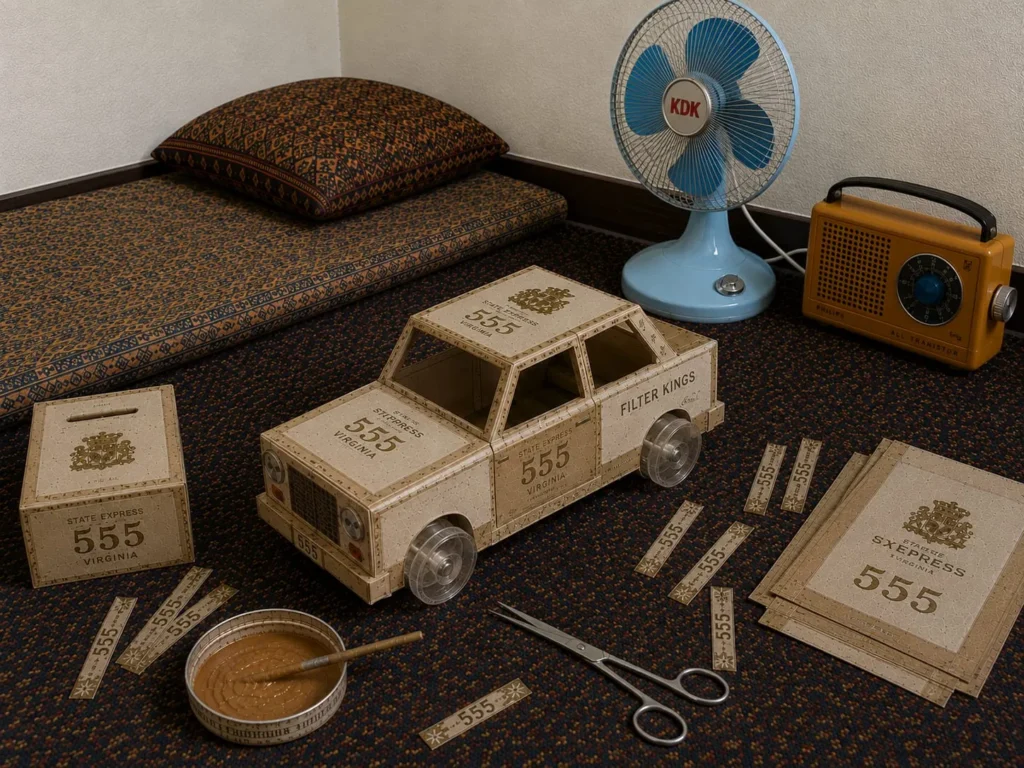
Long before I became an engineer, I had a small workshop at home. Unfortunately, most of my tools and quite a few of my spare parts belonged to my parents.
I remember my childhood even before I started school.
Life in the 1970s was very different from the childhood many children experience today.
For an ordinary middle-class family, priorities were clear: food, clothing, housing and education. Those were necessities. Toys belonged somewhere further down the list, in the category of nice to have, but certainly not necessary.
Today, children walk into a shop and toys are everywhere plastic toys, electronic toys, talking toys, moving toys, cheap toys and expensive toys. Sometimes it seems a child can come home with a new toy every time the family goes shopping.
For us, it was different.
Maybe you received a toy once a year.
Maybe somebody gave you one as a gift.
And if it broke?
Well…
You had approximately eleven months to think about it.
No Marbles, No Cards… and Definitely No Girls’ Games
The other boys in our street had their own games.
One popular game involved those beautiful little colored glass marbles. The boys would dig a small hole in the ground, throw five or seven marbles toward it, and then use another marble usually a different color to shoot them one by one into the hole.
It looked perfectly innocent to me.
My father disagreed.
I couldn’t understand why he wouldn’t let me join them.
Later, I discovered the missing part of the game.
Sometimes the boys were playing for small coins. If you won, your opponent paid you.
For my father, this required no further discussion.
Today marbles.
Tomorrow gambling.
No marbles.
Then there were playing cards.
That was even easier.
Playing cards simply didn’t exist in our house. I don’t think we owned a deck until I went to university.
So much for Plan B.
At home, there were three children. I was the eldest and the only boy, with two younger sisters.
They had each other.
They would draw lines and boxes on the ground in our garden and play jumping games, moving from one section to another without touching the lines.
Technically, I could have joined them.
But I was the eldest.
I was the only boy.
And I was a few years older.
My pride would not allow such a thing.
So there I was.
No marbles.
No cards.
No boys’ games.
And absolutely no possibility that I was going to spend my afternoon jumping around with my two little sisters.
I needed another solution.
My Seventy-Year-Old Playmate
The next available person at home was my father.
There was only one problem.
He was already in his seventies.
Not exactly the perfect age match for a small boy looking for somebody to play with.
But he became something much more important.
My father was one of my closest friends and my first teacher.
He had been a policeman. He was disciplined, knowledgeable, constantly reading and a man of very strong beliefs.
And when I say strict, I mean strict.
He had opinions about almost everything, and those opinions were generally not presented as suggestions.
I loved sitting with him, talking and listening.
But however wonderful your seventy-year-old father may be, sometimes a child still needs another child.
Or at least…
a toy.
And since neither seemed to be arriving, I started looking around the house.
My First Raw Material: Cigarette Boxes
My father smoked cigarettes, which was quite common in those days.
When he finished a packet, the empty box meant nothing to him.
To me, it was beautiful.
The cardboard was neat and strong. Some packets had shiny silver or golden wrapping inside.
I started collecting them.
My father saw rubbish.
I saw construction material.
Then there was our transistor radio.
My father loved the news. Every evening, I would sit beside him waiting for the BBC Persian programme, which started around 8 p.m.
But I was impatient, so I started listening earlier.
Before the Persian broadcast, there would be BBC programmes in Urdu or Hindi. I couldn’t understand much at first, but I listened anyway.
Then, at 8 p.m., I would hear many of the same international stories again in Persian.
Slowly I started connecting words.
Ahhh… so that word means this.
Without realizing it, I had created my own language course.
That is largely how I first began understanding Urdu and Hindi: sitting beside my father and his transistor radio.
But the radio also provided something else.
Batteries.
Big ones.
Dead Batteries Were Not Dead
Those old transistor radios used large cylindrical dry-cell batteries.
After some time, the batteries would lose their charge. My father would buy new ones and the old ones would be thrown away.
Except they weren’t thrown away.
Because I collected them.
A dead battery might be useless for a radio.
But perhaps it wasn’t useless for something else.
Soon my collection consisted of cigarette boxes, matchboxes, shiny wrapping paper and dead batteries.
I had materials.
Now I needed tools.
My father had a shaving kit.
Inside was a beautiful little pair of scissors.
Perfect for cutting cigarette boxes.
There was only one technical difficulty:
they belonged to my father.
So I developed an early procurement system.
I stole them.
Not permanently, of course.
I would borrow them without authorization, cut my cardboard, return them, wait until my father stopped complaining…
and steal them again.
We also had powdered glue at home. In those days, painters mixed chalk with a light-brown, plant-based adhesive for wall finishing. Mixed with water, the adhesive was also excellent for paper and cardboard.
Now my workshop was operational.
Cigarette boxes.
Matchboxes.
Old batteries.
Powdered glue.
And one illegally acquired pair of scissors.
There was only one question:
What should I manufacture?
Cars, Obviously
I loved cars.
Even as a young boy, I was fascinated by different manufacturers, models, shapes and countries of production.
So naturally, my first serious production line would be automobiles.
But I had to be realistic.
A Volkswagen Beetle?
Impossible.
Too many curves.
My technology consisted of cigarette cardboard and scissors. I needed a car that respected my manufacturing limitations.
So I started with an Opel.
Straighter body.
Simpler corners.
Much more cooperative.
I could make the body.
Then came the engineering challenge:
wheels.
Cardboard wheels weren’t good enough.
But I had been examining those old batteries.
At the top were round plastic and metal components that looked remarkably like wheels.
And inside was a black carbon rod that looked almost perfect for an axle.
My father had already warned us that batteries contained dangerous chemicals and that we shouldn’t put anything from inside them near our mouths. I understood that I had to be careful.
But the important discovery had already been made.
I had found wheels.
I had found an axle.
And soon…
I had a car.
It probably wouldn’t have impressed Mercedes-Benz.
But it impressed me.
Because I had made it myself.
Then I made another one.
And something interesting happened.
The second car was better.
The third was better than the second.
Each time I saw something that wasn’t quite right.
The proportions.
The shape.
The wheels.
The body.
So I changed it on the next one.
After a few years, I could make quite good models from cardboard and thicker paper.
And slowly, I became famous in the extended family.
Everyone started saying:
“This boy will become an engineer.”
Maybe they recognized talent.
Or perhaps engineer was simply the most respectable description they could find for a child who collected rubbish, dismantled batteries and repeatedly stole his father’s scissors.
Either way, they were right.
Then Cardboard Became Boring
Eventually, paper cars were no longer enough.
I could make something that looked like a car.
But what was the point of a car that couldn’t move?
A car should run.
A plane should fly.
A helicopter should…
well, at least make a serious effort.
And cars needed details.
Doors should open.
The bonnet should open.
The trunk should open.
Windows should be transparent.
And somewhere inside there should be an engine.
My ambitions had now moved considerably beyond the capabilities of cigarette boxes.
I needed metal.
Fortunately, my mother was unknowingly running an excellent raw-material supply chain.
My Father’s Guests and My Mother’s Ghee Cans
In our house, we used large square metal cans containing around 16 kilograms of ghee.
And those cans became empty surprisingly quickly.
There was a reason.
My father had another habit.
Before lunch, he would go to the mosque for the midday prayer.
Then he would come home.
With three people.
Sometimes four.
For lunch.
Without warning.
My mother would complain:
“Ayobi! At least tell me beforehand when you are bringing guests. Then I can prepare enough food!”
My father apparently considered advance notification incompatible with spontaneous Afghan hospitality.
Nothing changed.
So eventually my mother developed her own solution.
She simply started cooking every day for an extra three to five people.
If guests came, there was enough food.
If they didn’t, there was plenty left.
Problem solved.
And there was another beneficiary:
me.
More guests meant more food.
More food meant more ghee.
More ghee meant more empty cans.
More empty cans meant…
more cars.
Afghan hospitality was indirectly financing my automobile industry.
I began collecting everything.
Metal cans.
Wire.
Pieces of plastic.
Thin sheets of metal.
Boxes.
Anything around the house that looked useful.
Occasionally even a small piece of roofing material might mysteriously disappear if I concluded that it could serve a more important purpose.
The Workshop Goes Industrial
Metal required better tools.
Fortunately, the family had those too.
Hammer.
Pliers.
And my mother’s large sewing scissors.
My father’s little scissors had served the cardboard era.
My mother’s scissors were required for industrial expansion.
Again, authorization was a minor problem.
By this stage I had considerable experience in unauthorized procurement.
Now I could build metal cars, tanks, planes and helicopters.
But one problem remained.
They still didn’t move.
I needed a motor.
Where does a child in the 1970s find an electric motor?
You look around the house.
And then I remembered…
the fan.
The KDK Fan Incident
We had a KDK table fan.
During summer it was extremely useful.
During winter, nobody cared about it.
It sat quietly in the storage room for months.
Nobody remembered it.
Except me.
Because I knew something important:
there was a motor inside.
I developed what seemed to me a perfectly reasonable plan.
I wasn’t going to destroy the fan.
Of course not.
I would simply remove the motor temporarily.
Install it in my helicopter.
Conduct the necessary experiments.
Then, before summer, reinstall it in the fan.
Nobody would ever know.
Excellent plan.
So I dismantled the fan.
The motor was transferred from household cooling operations to the aviation sector.
My helicopter benefited enormously.
Winter passed peacefully.
Then summer arrived.
My father retrieved the fan.
He switched it on.
Nothing.
He tried again.
Nothing.
I don’t remember how long the investigation took before the responsible engineer was identified.
But I remember the next scene quite clearly.
My father had his belt.
I was running through the garden.
He was running behind me.
Apparently, my explanation concerning the temporary reassignment of household electrical assets to experimental aviation research was not convincing.
But who cared?
One or two hits with a leather belt seemed an acceptable price.
At least I had made something.
Nothing With a Motor Was Safe Anymore
Unfortunately for my parents, discovering electric motors changed everything.
From that moment onward, I looked at household appliances differently.
A normal child looked at a juicer and thought:
“Juice.”
I looked at a juicer and thought:
“Motor.”
A normal person looked at an electrical appliance and saw something useful.
I saw spare parts.
Fans.
Juicers.
Watches.
Electrical equipment.
Anything mechanical.
Anything with wires.
Anything with a motor.
Nothing was completely safe.
My father eventually developed an impressive historical record of my destruction.
“Look at this boy! He destroyed this many fans, this many electrical things, my watches, my scissors…”
The list grew longer every year.
Inside the house, my reputation was deteriorating rapidly.
Outside the house, however, something completely different was happening.
People were seeing what I was actually making.
Cars.
Tanks.
Airplanes.
Helicopters.
And eventually the news reached my school.
The Day My “Destroyed Things” Went to School
One day, the headmaster asked me to bring some of my handmade models.
So I did.
I brought my cars.
My tanks.
My airplanes.
My helicopters.
The headmaster and teachers looked at them.
And then something happened that I hadn’t expected.
They kept some of them.
Not because I was in trouble.
They put them in the school exhibition room.
I was incredibly proud.
The things that had caused so much trouble at home were now on display at school.
My father’s missing scissors had contributed to education.
The sacrificed appliances had not died in vain.
Even the KDK fan had made a contribution to science.
My teachers and headmaster began telling me that I should continue in this direction.
They encouraged me to enter a technical high school and study mechanics.
And eventually, I did.
Looking back, I sometimes wonder where that journey actually started.
Was it when my teachers encouraged me?
When my first homemade car moved?
When I discovered the motor inside the fan?
When I opened my first battery?
Or perhaps much earlier when my father told me I couldn’t play marbles with the other boys, I refused to play my sisters’ games, and there was nobody else at home except a seventy-year-old former policeman who preferred reading books and listening to the BBC.
I didn’t have many toys.
So I made them.
I didn’t have materials.
So I found them.
I didn’t have tools.
So…
well, I stole my parents’ scissors.
And whenever something didn’t work, I tried something else.
Years later, people would call me an engineer.
But perhaps the journey started long before I knew what the word engineer meant.
And that is another story.
• Because once I entered technical school, the problems and the experiments became much bigger.