
Integrity does not begin when we become managers or leaders.
I believe it begins much earlier, in our families, in the values we learn from our parents, in religion, education, community, and the examples we see around us as children and young adults.
For me, being known as an honest person was always a source of pride. Over time, you build a reputation for being genuine, trustworthy, and principled. And once you have built that reputation, you understand how easily it can be damaged.
It may take decades to build a reputation and only one bad decision to put it at risk.
When I joined the Red Cross and Red Crescent Movement, those personal values became professional obligations as well. Integrity was part of our Code of Conduct, but for me it was more than a written requirement.
If you want people to trust you with greater responsibilities one day, with people, programmes, resources, and millions of dollars of humanitarian funding, you have to demonstrate that you can be trusted when nobody is watching and, perhaps more importantly, when doing the right thing is inconvenient.
That sounds simple.
In reality, it can be one of the hardest parts of a career.
When Integrity Has a Price
During my years managing programmes in Afghanistan, I was responsible for work across five delegations. Part of my responsibility was ensuring the quality of construction being implemented by contractors.
I encountered situations where some site supervisors appeared willing to overlook poor-quality construction while maintaining good relationships with contractors. At the same time, I was seen as being too demanding and too hard on some staff because I insisted that construction standards be respected.
That created an uncomfortable situation.
People who were unhappy with my standards could present themselves upward as cooperative and easy to work with, while I could be portrayed as the difficult manager.
And sometimes organizations reward harmony more quickly than they recognize integrity.
I received criticism about the way I managed people. But from my perspective, lowering standards simply to become more popular was not an option. These were humanitarian resources, and the buildings and infrastructure we constructed would eventually be used by people who trusted us to do the job properly.
Eventually, the situation became one of the reasons I decided to leave that position.
But I did not compromise my principles before leaving.
At the time, I sometimes wondered whether I should have handled it differently.
My next assignment gave me the opportunity to answer that question.
Indonesia: The Same Test, A Different Response
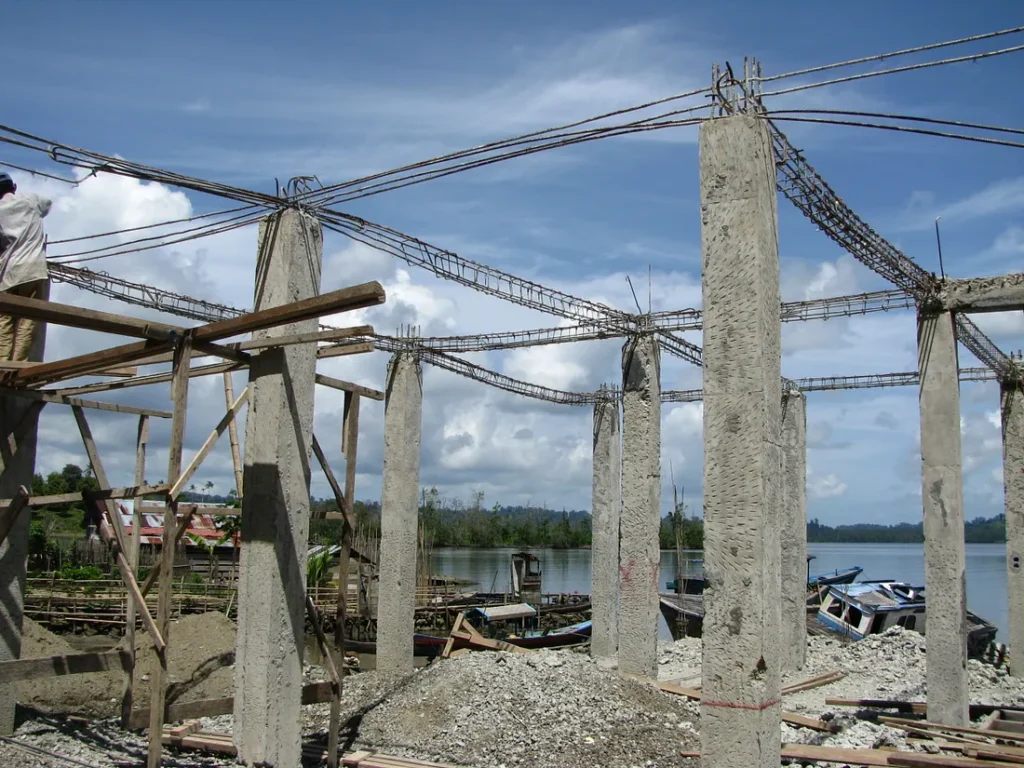
When I later joined an assignment in Indonesia, initially as a water and sanitation delegate, I arrived on an island where two major construction contracts had already been awarded.
One was for a reinforced-concrete water reservoir with a capacity of approximately 400,000 litres.
What I found concerned me immediately.
The contractor responsible for the project appeared to have very limited operational capacity on the island. The actual construction had effectively been passed down to local workers who did not have the engineering support, equipment, or technical capacity I believed such a structure required.
As a professional engineer, I could not ignore what I was seeing.
When sections were constructed below acceptable standards, I rejected them. Sometimes a wall built one day had to be demolished the next because the workmanship was unacceptable.
Naturally, this did not make me popular.
Then I became concerned about another project, a market building being constructed under a different programme. I was not initially responsible for supervising it, but when I inspected the structure, I saw cracks and what I considered serious design and construction deficiencies.
I volunteered to take responsibility for its technical supervision as well.
Now I had two problematic construction projects involving the same contractor.
And the conflict intensified.
I stopped work whenever I believed it did not meet acceptable standards. Eventually, concerns about my approach reached senior management, and I was encouraged to allow the contractor to complete the work.
I refused.
I warned management that if the building continued in that condition, another significant earthquake could cause serious structural failure.
At one point my manager asked me, in effect:
Should I trust someone who has just joined the organization, or the consultants and contractors who have worked with us for years?
My answer was simple:
If you have sent me here as the engineer responsible for supervising this work, then you should trust my professional judgment. If you cannot trust me, send me home.
But I could not approve work that I believed was unsafe.
That was the moment when my earlier experience in Afghanistan became important.
In Afghanistan, I had eventually walked away from a situation where maintaining my principles had become extremely difficult.
In Indonesia, I decided that I would not walk away.
If the organization wanted to send me home for refusing to approve substandard construction, I was prepared to accept that.
But I would not sign my name to something I did not believe was right.
Then the Earthquake Came
About eighteen months later, a magnitude 7.5 earthquake struck the area.
The market building I had warned about was severely damaged. Around 70 percent of the structure collapsed or suffered such extensive damage that repairing it was no longer a realistic option.
It had to be demolished and rebuilt.
It was not a moment to celebrate being right. A failed building is never something an engineer wants to see.
But it demonstrated why professional integrity matters.
Quality standards are not paperwork.
Engineering standards are not bureaucracy.
And sometimes the person who keeps saying no is not trying to make life difficult. They may be trying to prevent something much worse from happening.
After the earthquake, the situation changed completely.
I was given responsibility for completing the work. We went through proper procurement processes, selected reputable contractors with the required technical capacity, and completed both projects within approximately five months.
The same person who had once been considered too difficult was now trusted to solve the problem.
Integrity Is Also What Others Learn From You
But integrity is not only about protecting your own name or reputation.
As leaders, whether we realize it or not, people are watching us, our children, our families, our colleagues, our teams, the organizations we represent, the National Societies we work with, and the communities we serve.
That gives leadership another responsibility: to be an example.
I learned many of my values as a child from my parents, religion, education, and the people around me. Later in life, I realized that we pass those values to the next generation in much the same way, not only through what we tell them, but through what they see us doing.
You can tell your children to be honest a hundred times. But seeing you remain honest when dishonesty could benefit you teaches them much more.
The same is true in leadership.
If I expect my team to protect humanitarian resources, follow procedures, reject corruption, maintain professional standards, and treat people fairly, they must see me doing exactly the same.
I cannot ask them to maintain standards that I am personally willing to compromise.
A leader’s behaviour quietly establishes what is acceptable.
If the leader takes shortcuts, others learn that shortcuts are acceptable. If the leader tolerates wrongdoing, people understand that wrongdoing can be tolerated. And if a leader benefits personally from something that is wrong, it becomes very difficult for that same leader to tell others to behave differently.
But the opposite is also true.
When your team knows that you will not misuse resources, they understand that they should not either. When they see you refusing improper influence, they know where the line is. When they see you standing by professional and ethical standards even when there is a personal cost, it gives them confidence to do the same.
This is particularly important in humanitarian work because we do not work only within our own organizations. We work alongside National Societies, volunteers, communities, governments, partners, contractors, and donors.
Our behaviour contributes to how all of them see the organization and the principles we represent.
And the influence may continue long after we leave.
Your children may carry those values into their own lives. A colleague may take them into another organization. Someone you once supervised may become a manager and lead another team according to the standards they saw from you.
In that sense, integrity becomes part of a leader’s legacy.
We inherit values from those who came before us. We live those values through our own choices. And through our example, we pass them to those who come after us.
Integrity Is Tested Before It Is Recognized
Integrity is easy when everyone agrees with you.
Its real test comes when standing by your principles makes you unpopular.
Sometimes it may affect your appraisal. Sometimes colleagues may misunderstand you. Sometimes people with stronger relationships or greater influence may appear to win. And sometimes even your own manager may ask you to compromise because doing so seems easier for the organization.
Those are precisely the moments when integrity matters most.
This does not mean believing that we are always right.
Integrity also requires humility, the willingness to listen, reconsider evidence, acknowledge mistakes, and change our position when someone else has a better argument.
But once the evidence is clear and the issue involves safety, ethics, misuse of resources, or the trust placed in us, leadership sometimes requires standing alone.
I learned that lesson the difficult way in Afghanistan.
I applied it differently in Indonesia.
And I have carried it with me ever since.
Because positions eventually end. Organizations change. Managers come and go.
But your name follows you.
After more than three decades in humanitarian work, I still believe that one of the most valuable things a leader can protect is not their title or position.
It is their integrity.
And perhaps the greatest value of protecting it is that integrity does not end with you.
People see it. People learn from it. And some of them will carry it forward.