
Part 1: When Emergency Response Must Become Recovery
Four months after Super Typhoon Haiyan struck the Philippines, I arrived in a country that was no longer in the first days of an emergency, but was nowhere near recovered.
That distinction matters.
The television images of November 2013 showed the immediate catastrophe: communities flattened, families searching for relatives, hospitals overwhelmed, communications cut, roads blocked and hundreds of thousands of people without adequate shelter.
Four months later, the immediate emergency phase was beginning to give way to a different challenge: recovery.
Lives had been saved and emergency assistance was reaching communities, but hundreds of thousands of families were still facing the longer-term consequences of Haiyan. The question was no longer only how to meet today’s urgent needs, but how to help people rebuild their homes, livelihoods and lives in a way that would leave them safer for the future.
By April 2014, official figures recorded more than 16 million people affected, around 4.1 million displaced, 6,300 deaths and more than one million damaged houses. Nearly 490,000 homes had been completely destroyed.
Behind those statistics were families trying to answer much simpler questions:
Where will we live? How will we earn money? Can we rebuild here? And when will life become normal again?
I arrived in April 2014 for my first assignment in the Philippines, as Country Representative of the Norwegian Red Cross.
The Norwegian Red Cross had raised approximately CHF 20 million for the Haiyan response.
So, theoretically, we had what humanitarian organizations often desperately need:
money.
What we did not yet have was something equally important:
a way to turn that money quickly into recovery.
The Emergency Was Enormous, but Recovery Was Even More Complicated
The first phase following Haiyan had understandably concentrated on saving lives and meeting immediate needs.
Food. Water. Medical assistance. Emergency shelter. Household items. Cash. Restoring contact between separated family members.
The Philippine Red Cross, supported by the wider Red Cross and Red Crescent Movement, mounted an extraordinary response. Within the first year, PRC had provided emergency shelter assistance to nearly 624,000 people, almost one quarter of affected households.
But emergency relief has a natural limitation.
A tarpaulin can protect a family tonight.
It does not answer where that family will live next year.
A food distribution can help someone survive this week.
It does not restore the fishing boat, coconut farm, shop or income that supported the family before the disaster.
And emergency medical teams can save lives.
They cannot remain forever.
This is the point at which humanitarian operations become much harder.
Response is largely about urgency. Recovery is about choices.
What should we rebuild? Where? For whom? To what standard? Using which materials? Who owns the land? Will the family still have a livelihood there? And will what we build survive the next disaster?
By February 2014, the wider humanitarian response was already shifting its attention from relief toward recovery. The Philippine Red Cross and its Movement partners were doing the same.
The assessment was no longer simply asking:
What did people lose? It was beginning to ask:
What will allow communities to recover and become less vulnerable next time?
When I arrived, I found something that has stayed with me throughout my career.
Humanitarian organizations can have funding, international experts, approved plans and very good intentions and still struggle to move.
Haiyan had generated an enormous international response.
There were the Philippine Red Cross, IFRC, ICRC and numerous Partner National Societies.
Government was rebuilding.
UN agencies and NGOs were operating.
Communities themselves were rebuilding.
Everyone needed construction materials.
Everyone needed carpenters.
Everyone needed transportation.
Everyone needed warehouses.
Everyone needed access.
And very often, everyone needed the same things at the same time.
One of them was particularly important:
CGI roofing sheets.
Without a roof, you do not have a house.
The problem was that everybody needed CGI.
Supply could not instantly expand simply because humanitarian organizations had budgets.
That is an important lesson from large-scale disasters:
«Money does not automatically create supply.»
You can have CHF 20 million available and still not have the roofing sheet you need tomorrow.
And if an operation does not solve that problem, its programme remains a spreadsheet.
The Disaster Had Destroyed Homes. But Also the Supply Chain
Haiyan was not simply a shelter disaster.
It disrupted the system needed to rebuild the shelter.
Materials were scarce.
Transport was difficult.
Local production capacity was under pressure.
Skilled workers were suddenly in enormous demand.
Markets were recovering unevenly.
Even materials lying on the ground presented both a problem and an opportunity.
Millions of coconut trees had been damaged.
The Red Cross recovery assessment specifically identified fallen coconut timber as something that needed to be harvested and processed quickly before it deteriorated.
That was not merely a construction issue.
It could also become a livelihood activity.
And that illustrates something fundamental about recovery:
A destroyed coconut tree can be debris, building material, lost income or a new livelihood opportunity, depending on how the programme looks at it.
Recovery therefore cannot be managed sector by sector as if shelter, livelihoods, WASH and communities exist independently of each other.
They don’t.
Stop Waiting. Find the Constraint.
When I arrived, many people were still trying to work out how to move forward.
Some had brought in technical specialists.
Some were developing designs.
Some were waiting for materials.
Some were working through procurement and coordination systems.
Some were waiting for decisions.
And some seemed to believe that once all the processes were completed, implementation would somehow begin.
I have always looked at operations somewhat differently.
Perhaps that comes from being an engineer.
When something is not moving, I want to know:
What exactly is stopping it?
Not ten problems.
The problem that is preventing the next step.
Then solve it.
At that moment, one of our major constraints was materials.
I had spent many years working with the ICRC before joining the Norwegian Red Cross. I knew many colleagues there from earlier missions. The head of shelter was my former supervisor. Other senior colleagues had worked with me in Afghanistan and elsewhere.
So I approached them.
We found a solution.
The materials required for our shelter programme could be obtained through the ICRC supply arrangement, with the Norwegian Red Cross paying for those materials.
That unlocked the programme.
It was a relatively simple decision.
But sometimes the difference between a programme moving and a programme waiting is one person deciding that waiting is no longer an acceptable strategy.
This is one of the most important leadership lessons I took from Haiyan.
A leader in an emergency does not need to personally solve every technical problem.
But a leader must continuously ask:
What is preventing us from delivering today?
And then remove that obstacle.
And there was another issue I observed.
Humanitarian professionals understandably want to produce good work.
Architects want good designs.
Engineers want safe structures.
Programme managers want proper systems.
Finance departments want controls.
Procurement departments want compliant processes.
Donors want accountability.
All of these are necessary.
But after a disaster, there is another variable:
time.
A family living under a tarpaulin experiences time differently from an architect sitting with a drawing.
A fisherman without a boat experiences time differently from a programme manager waiting for the next coordination meeting.
A mother living with children in temporary accommodation experiences time differently from a procurement system.
Quality matters.
Accountability matters.
Standards matter.
But humanitarian organizations should never confuse complexity with quality.
Sometimes we make programmes complicated because our systems are complicated, not because people’s problems require complicated solutions.
Haiyan reinforced a principle that has guided much of my work:
«Do not search endlessly for the perfect solution when a safe, appropriate and sustainable solution can start helping people today.»
Do We Really Need to Build the Same House Three Times?
Shelter recovery also made me question one of the conventional ways humanitarian programmes think.
We often describe shelter as a sequence:
Emergency shelter.
Then:
Transitional shelter.
Then:
Permanent housing.
On paper it looks logical.
From the family’s perspective, it can look very different.
First, somebody assesses them.
Then somebody selects them.
Materials are procured.
Materials are transported.
An emergency shelter is provided.
Months later another programme may assess them again.
Another procurement process begins.
Another shelter is constructed.
Then, theoretically, permanent reconstruction comes later.
But will it?
Will the donor still be there?
Will the organization still have funding?
Will the family still qualify?
Will the land issue have been resolved?
And how much money will have been consumed building temporary solutions along the way?
There are certainly circumstances where emergency and transitional shelter are essential.
But they should be tools, not automatic stages.
If the emergency phase has passed, the land is safe, the family can remain there and we have the resources to construct something durable, why deliberately build something we already know must be replaced?
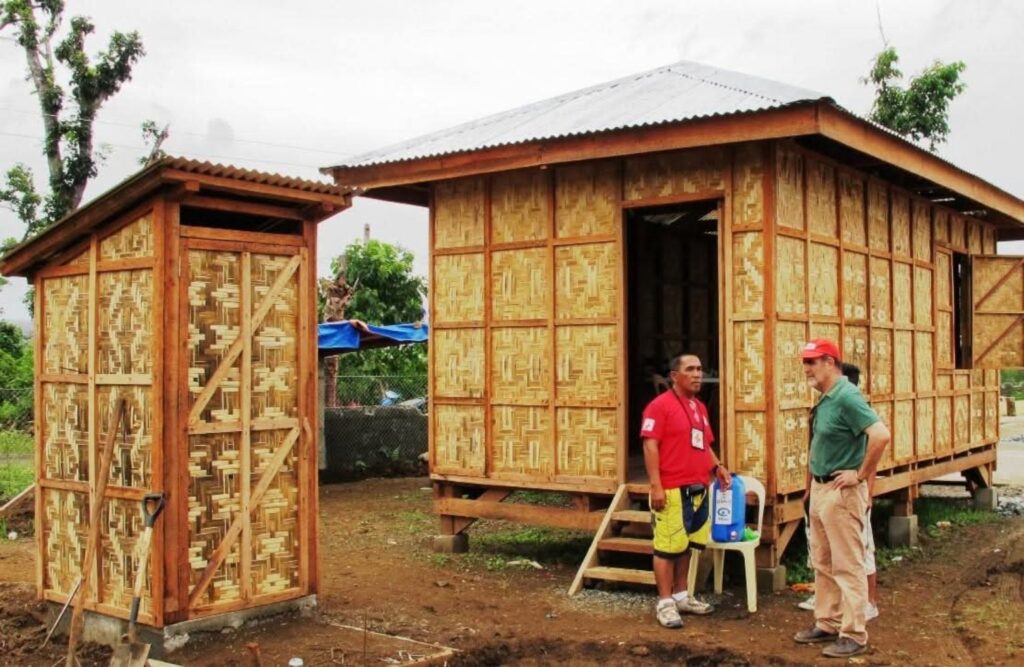
The Red Cross approach after Haiyan increasingly centred on core shelters: structures that could provide a safe starting point while allowing families themselves to extend and improve them.
That concept matters enormously.
Because recovery does not have to mean:
We build everything for you.
It can mean:
We help you reach a safe point from which you can continue rebuilding your own life.
The Best House Is Not Necessarily the Most Expensive House
This is another lesson engineers and architects working in humanitarian settings need to understand.
A technically impressive house that local people cannot maintain, repair, reproduce or extend may be less sustainable than a simpler design they understand.
The Red Cross used local materials where appropriate and trained carpenters and craftsmen in safer construction.
Within the first year of the Haiyan recovery operation, more than 1,800 carpenters and craftsmen had already been trained.
Beneficiaries themselves contributed labour what was often called “sweat equity.”
Families did not simply receive houses.
They participated in constructing them.
And something important happened afterwards.
People started changing the houses.
They added porches.
They extended rooms.
They adapted them to their families.
To an architect, modification of a standardized design can sometimes look like loss of control.
To me, it can also be evidence of ownership.
A humanitarian house should not become a monument to the organization that funded it.
It should become somebody’s home.
Filipinos Were Already Recovering Before We Arrived
This deserves emphasis.
One of the biggest mistakes humanitarian organizations can make after a disaster is unconsciously treating affected people as passive beneficiaries.
Filipinos were not sitting among the ruins waiting for international organizations to rescue them.
They were already rebuilding.
They salvaged materials.
They repaired roofs.
They helped neighbours.
They found timber.
They restarted businesses.
They borrowed money.
They found temporary work.
They adapted.
Our own recovery assessments found markets functioning again sufficiently to support cash-based approaches.
That changes the humanitarian question.
Instead of asking:
What can we do for these people?
we should ask:
What are people already doing to recover, and what is preventing them from going faster?
Sometimes the answer is money.
Sometimes materials.
Sometimes technical knowledge.
Sometimes land.
Sometimes government policy.
Sometimes access to markets.
Good humanitarian assistance identifies that missing piece.
Then it strengthens what people are already doing.
But Not Every Family Had the Same Problem
This became very clear in shelter.
There were families whose homes were damaged but repairable.
Why construct a new house when roofing sheets, fixings, tools, materials and safer-construction advice could enable them to repair the house they already owned?
Then there were families whose houses had been completely destroyed but who could rebuild on their existing land.
A core house made sense.
Give them a safe structure.
Give them sanitation.
Help them build back safer.
And make sure the structure can grow as the family’s resources recover.
Then there was a third category.
And this was where shelter stopped being mainly an engineering problem.
What If We Build You a House — But Destroy Your Life?
Thousands of families had been living in coastal or otherwise high-risk areas.
After Haiyan, no-build-zone policies and relocation proposals created an enormous challenge.
The recovery assessment identified exactly the problems we were seeing.
There was insufficient relocation land.
Many families did not possess formal land documentation.
Some people did not want to relocate.
And relocation could separate families from the livelihoods that sustained them.
Imagine a fisherman.
We can relocate his family away from the coastline and proudly announce:
“Shelter completed.”
But where is his boat?
How does he reach the sea every morning?
How much does transportation cost?
Where are his customers?
Where do his children go to school?
Where is water?
Electricity?
Health care?
Markets?
If we give someone a safer house but make it impossible for them to earn a living, have we reduced vulnerability?
Or have we simply exchanged one vulnerability for another?
The Movement’s own recovery assessment eventually called for relocation to be accompanied by integrated planning for infrastructure, livelihoods and social services.
That sentence captures one of the most important lessons of Haiyan:
«A house is a structure. Recovery is a system.»
Shelter Without Livelihood Is Not Recovery
The livelihood damage was enormous.
Agriculture and fisheries were major sources of income in affected areas.
Coconut farmers were particularly vulnerable. In Eastern Visayas alone, around 1.7 million people were directly involved in coconut growing and copra production, and the recovery assessment estimated that coconut farming could take six to seven years to re-establish.
Fishermen lost boats.
Farmers lost crops and agricultural inputs.
Small vendors lost stalls.
Families borrowed money and accumulated debt.
Daily labour opportunities declined just when more people were looking for work.
This is why the recovery assessment concluded that livelihoods needed to be addressed together with shelter, not afterwards.
That is a very different philosophy from:
First build houses.
Then do WASH.
Then livelihoods.
Then DRR.
Then close the project.
People do not live in sectors.
Humanitarian organizations created sectors to organize ourselves. Communities never asked to be divided into them.
Neither Is Shelter Without Water and Sanitation
The same principle applied to WASH.
A house without safe water and sanitation is not adequate recovery.
In our programme, shelter and WASH therefore belonged together.
The wider ICRC/Philippine Red Cross operation and the IFRC recovery strategy similarly integrated shelter, livelihoods, health, water and sanitation, organizational development, disaster risk reduction and community engagement.
This wasn’t integration for the sake of humanitarian terminology.
It reflected how people actually live.
A family does not wake up thinking:
“Today I am a shelter beneficiary.”
Tomorrow:
“I am a WASH beneficiary.”
Wednesday:
“I am a livelihood beneficiary.”
They are simply trying to rebuild a life.
Recovery Starts Before Relief Ends
This may be the most important lesson from Haiyan.
We often draw disaster management as a neat line:
Emergency → Relief → Recovery → Development → Resilience
Real life does not work that way.
Markets begin recovering while food is still being distributed.
Families start rebuilding while shelter assessments are still underway.
People search for jobs while they are still living in temporary accommodation.
Government starts planning reconstruction while humanitarian organizations are still delivering relief.
And disaster risk reduction should begin before the last emergency distribution has finished.
The IFRC recovery assessment recognized this early. It concluded that greater sustainable impact would come from community-based, integrated programming combining shelter, livelihoods, health, WASH, safer reconstruction and disaster risk reduction.
That is an important principle.
Recovery does not begin when emergency response ends.
It begins while the emergency is still happening.
The First Step Toward Resilience Is Not a DRR Workshop
When humanitarian organizations talk about resilience, we sometimes immediately think about training, preparedness plans, early-warning systems or disaster-risk-reduction projects.
Those are important.
But Haiyan taught me something more basic.
The first step toward resilience may simply be making the right recovery decision today.
Repair instead of replace when repair is sufficient.
Build durable rather than repeatedly temporary where circumstances allow.
Use local capacity rather than replacing it.
Train carpenters rather than importing all the expertise.
Use fallen coconut trees rather than treating everything as waste.
Help markets recover rather than creating parallel supply systems forever.
Connect shelter to livelihoods.
Connect relocation to infrastructure and employment.
Connect construction to future hazards.
And above all:
do not rebuild the vulnerability that existed before the disaster.
That is where resilience starts.
What Haiyan Changed for Me
I came to the Philippines to help deliver a recovery programme.
But Haiyan strengthened something much larger in my own thinking.
As an engineer, it is easy to measure success through outputs:
How many houses?
How many latrines?
How many kilometres of water system?
How much money spent?
How quickly completed?
Those numbers matter.
But after decades in humanitarian work, I increasingly ask different questions.
Did the family become safer?
Can they maintain what we built?
Can they extend it themselves?
Did their livelihood recover?
Did the community gain knowledge?
Did local organizations become stronger?
Will government systems work better next time?
And when the next typhoon comes, because in the Philippines another one will come, will fewer people need us?
That final question may be the most important measure of humanitarian success.
The purpose of recovery should not be to make communities better at receiving assistance.
It should be to make them less dependent on needing it.
Haiyan began with one of the largest humanitarian emergencies the Philippines had ever experienced.
For me, however, its most important lessons came afterwards.
They came when emergency distributions were ending.
When markets were returning.
When families wanted permanent solutions.
When organizations had to stop asking what they could distribute and start asking what people needed to rebuild their lives.
That is the difficult space between response and resilience.
And that is where this story really begins.
Next: pp Part 2: From Rebuilding Houses to Building Resilience
The next question is harder.
What happens after the houses have been built, the latrines completed, livelihoods restarted and humanitarian organizations begin leaving?
Because surviving one disaster does not make a community resilient.
The real test comes when the next disaster arrives.