
Diplomacy is often associated with ambassadors, foreign ministries, and negotiating tables.
But I learned diplomacy somewhere very different.
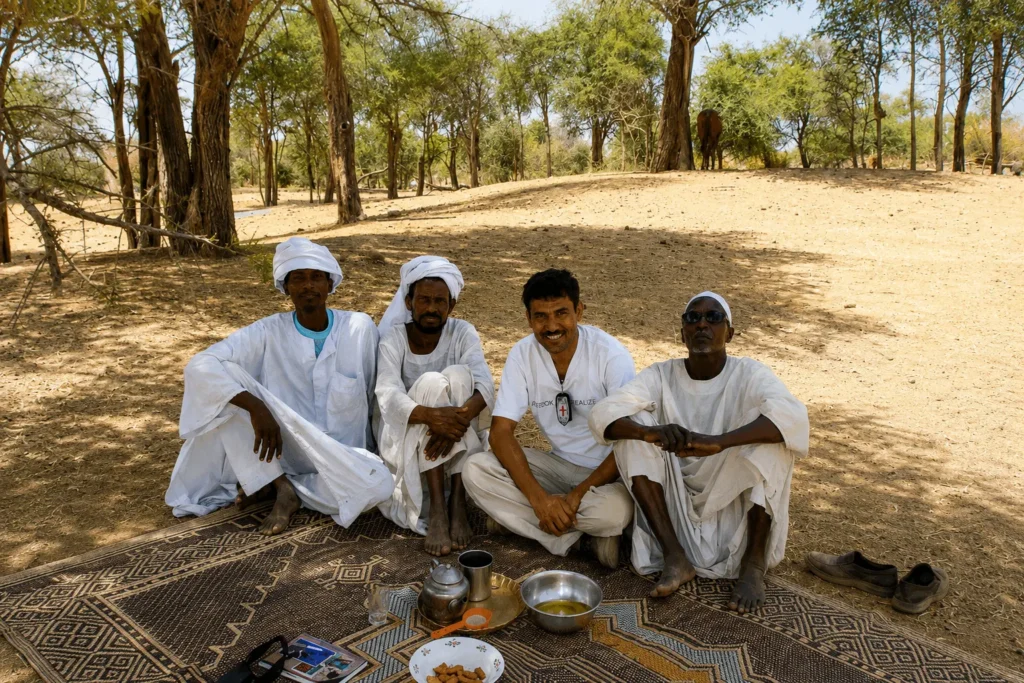
I learned it while working in conflict zones and disaster-affected communities, negotiating access at checkpoints, supporting humanitarian work in prisons and hospitals, engaging with government authorities and community leaders, and sometimes simply sitting over a cup of tea with people whose interests and perspectives were very different from mine.
These were not diplomatic assignments in the traditional sense. But they taught me that humanitarian leadership often requires diplomacy every day.
Over more than three decades of humanitarian work, I came to understand that leadership is rarely about having enough authority to tell people what to do.
More often, it is about finding enough common ground for people to move forward together.
Learning to Stay Outside the Politics
Perhaps my first lessons in political sensitivity came long before I became a humanitarian worker.
I grew up in Afghanistan during extraordinary political change, from the monarchy and the first republic to communist governments, the Soviet intervention, conflict, and eventually civil war.
By the time I was in high school and university, politics was everywhere. Students, particularly those who performed well academically, could face pressure to associate themselves with political movements.
My family had strong views about what was happening in the country, but I made a conscious decision not to join a political party.
That did not mean ignoring politics.
Quite the opposite.
To remain outside politics, I first had to understand it.
I had to understand who held power, what different groups believed, what could create suspicion, when to speak, and sometimes when not to speak.
Years later, when I joined the International Committee of the Red Cross, I discovered humanitarian principles, neutrality, impartiality, independence and humanity, and they immediately made sense to me.
They gave professional language to something life had already begun teaching me:
You can understand politics without becoming political.
That distinction became essential throughout my humanitarian career.
Principles Are Not Enough
Early in my career, however, I also learned that being principled does not automatically make someone diplomatic.
In 1992, while working at a hospital in Afghanistan, I dealt with a powerful and demanding hospital director.
I was young, technically confident, and very black-and-white in my approach.
When I believed a request was inappropriate, my answer was simple:
No.
One disagreement, even involving something as small as ten light bulbs, eventually contributed to a situation in which I was detained.
It was certainly not the way I would handle the same situation today.
But it taught me an important lesson.
My principles were not necessarily wrong.
My approach needed to mature.
Saying no is sometimes necessary. But before saying no, a leader should understand what sits behind the request.
Why does this person want it?
What problem are they trying to solve?
Is there another legitimate way to address that concern?
Where is the boundary I cannot cross, and where is there room to move?
I gradually learned that diplomacy does not mean compromising your principles.
It means protecting your principles while searching for a solution that others can live with.
Impartiality Has to Be Visible
Afghanistan later gave me an extraordinary opportunity to put that principle into practice.
At one point, my work regularly took me between two opposing sides of the conflict.
In Kandahar, I supported water and sanitation improvements in Sarpoza Prison, where detainees associated with the Northern Alliance were being held.
Then I would travel to Panjshir Valley, controlled by the Northern Alliance, where I worked on hospital rehabilitation and supported water and sanitation activities in places where Taliban detainees were held.
The politics could not have been more different.
My humanitarian purpose was exactly the same.
Improve conditions for people who needed assistance.
I was questioned and sometimes viewed with suspicion. But over time, both sides could see something important:
I wasn’t there because of who the detainees were. I was there because of their humanitarian needs and the mandate of the organization I represented.
That experience reinforced my belief that impartiality cannot simply be written into an organization’s principles.
People need to see it in your behaviour.
When you apply the same principles to people on opposite sides of a conflict, neutrality becomes something others can observe rather than something you merely claim.
Relationships Are Built Before You Need Them
Another lesson took me longer to fully appreciate.
You cannot start building a relationship on the day you need a favour.
Whenever I entered a new mission or began working in a new province, I increasingly made it a priority to understand the leadership around me.
Who is the governor?
Who are the mayors?
Who are the community leaders?
Who influences decisions formally, and informally?
And importantly, relationships should not exist only at the highest level.
Strong relationships have to exist across organizations and communities.
I learned this partly from situations that did not go well.
During the Typhoon Haiyan recovery in the Philippines, I was leading the country operation of a Partner National Society. One of our major programmes was constructing shelters for more than 1,000 families in Eastern Samar.
At one point, a disagreement emerged with a municipal mayor over beneficiary selection. The mayor believed that some local Red Cross volunteers involved in the process were favoring people associated with the political opposition and questioned whether the selection was respecting Red Cross principles.
Whether or not those concerns were justified, they needed to be heard and addressed carefully.
Unfortunately, the discussion became increasingly confrontational. Our programme leadership took a very black-and-white approach: the beneficiary-selection process had to remain independent and political influence could not be accepted. The principle was correct, but there was little room for dialogue around the concern behind the mayor’s position.
The disagreement escalated to the point where the mayor threatened to ask the Red Cross to leave the municipality. What could perhaps have been addressed locally through listening, explanation, evidence, and relationship-building became a much larger institutional issue. Eventually, senior Philippine Red Cross leadership intervened and helped resolve the situation.
I carried that experience with me.
It taught me that being right on principle does not automatically mean we are handling a situation well.
The mayor’s demand could not simply determine who received humanitarian assistance. That boundary was clear. But protecting that boundary did not require turning the relationship into a confrontation.
We could listen.
We could explain how beneficiaries were selected.
We could examine the allegations together.
We could correct any genuine problem if one existed.
And we could do all of that without surrendering the independence or impartiality of the Red Cross.
Years later, when we began working in Catanduanes, I approached local-government relationships differently.
Before there was a problem to solve, I made it a priority to establish relationships with the governor, mayors, and other local leaders. We discussed what the Red Cross could do, but equally importantly, what it could not do and why.
The objective was not to gain political protection. It was to create mutual understanding before difficult conversations became necessary.
For several years, we worked without the kind of confrontation I had experienced during the Haiyan recovery. And when local authorities raised legitimate community needs, we could discuss them openly rather than immediately seeing them as interference.
That experience changed the way I think about diplomacy:
Sometimes the principle behind a “no” is absolutely right. The leadership challenge is finding a way to say it without closing the door to the relationship.
At one point, the governor raised the difficulties facing abaca farmers and asked whether there was a way we could support them.
It was a reasonable humanitarian and livelihood concern.
Instead of seeing the request as interference in our programme, we explored whether the need fitted our objectives and donor requirements.
It did.
With USAID support, assistance ultimately reached farmers directly.
The local government was satisfied.
The communities benefited. The donor objectives were respected.
The Philippine Red Cross and our programme could support a legitimate need.
Nobody had to lose for someone else to win.
That, to me, is successful negotiation.
Sometimes Negotiation Begins With Listening
Perhaps one of my strongest lessons in negotiation came in Darfur, Sudan.
Humanitarian access to some vulnerable communities was extremely difficult. Movement through certain areas carried significant risks, and humanitarian vehicles and personnel could face interference from armed actors.
The obvious reaction could have been simply to demand access.
Instead, with the support of my supervisor, I tried first to understand the problem.
Why was humanitarian movement being obstructed?
What were the concerns?
What did the people controlling access actually need?
I spent time talking with community leaders and people who had influence in the area.
Being Muslim helped create an initial cultural connection. Understanding how to approach local leaders helped too.
But those things only opened the conversation.
Listening changed it.
Eventually, what appeared to be a complicated security and access problem revealed a surprisingly practical underlying need:
water.
People and their animals needed access to a reliable water source.
Water was within our humanitarian mandate.
We had the technical capacity.
Resources were available.
Suddenly, instead of asking only:
How do we convince them to let us through?
we could ask:
Is there a legitimate humanitarian need here that we can address while also improving access for others?
There was.
But principles still mattered.
The solution could not become a private benefit for an individual leader. Any water point had to serve the wider community.
So we worked with local leaders and communities around an arrangement that provided public access.
The relationship changed.
And humanitarian access became possible.
That experience stayed with me because it taught me something fundamental about negotiation:
The position people present is not always the interest underneath it.
Sometimes a “no” is not really a no.
Sometimes it means:
You haven’t understood my concern yet.
Bringing Organizations Around One Table
The same principle applies between organizations.
During my years in the Philippines, I worked in an environment involving the Philippine Red Cross, IFRC, ICRC, and numerous Partner National Societies, each with its own mandate, priorities, funding, programmes, and institutional interests.
Coordination could easily become a series of organizations explaining what each was doing separately.
I believed we could do more.
That thinking contributed to our work around collective impact and the idea of a One Philippine Red Cross Plan: starting with the priorities of the National Society and asking how different partners could complement one another around shared objectives rather than building separate plans around themselves.
It did not require everyone to surrender their identity or mandate.
It required finding the space where our interests overlapped.
We saw that approach work through joint initiatives, shared assessments, fund-generation workshops, disaster risk reduction activities, and other areas where partners could contribute different strengths toward common outcomes.
That experience reinforced another lesson:
Convening is not getting everyone into the same room.
It is helping people understand why achieving something together may be more valuable than achieving it separately.
Culture Is Not a Side Issue
Across all these experiences, cultural intelligence has been essential.
Afghanistan itself taught me this early.
Travel from one province to another and language, food, traditions, power structures, attitudes and ways of communicating can change significantly.
Later, working across Asia, Africa, the Caribbean and the Pacific and travelling much more widely, I learned that there is rarely only one “normal” way of doing things.
Something that seems perfectly reasonable in one culture may appear disrespectful in another.
Silence can mean disagreement in one place and respect in another.
A direct answer can be appreciated somewhere and damaging somewhere else.
Hierarchy matters differently.
Religion matters differently.
Time matters differently.
Even the way people say “no” differs.
Cultural intelligence does not mean knowing everything about another culture.
It begins with knowing that your own way is not the only way.
Principles Define the Boundary. Diplomacy Finds the Space.
Looking back, I see a common thread running through these experiences.
Political sensitivity taught me to understand the environment without becoming part of its politics.
Impartiality taught me to look at needs rather than identities.
Relationships taught me to build trust before I needed something.
Negotiation taught me to listen for interests behind positions.
Cultural intelligence taught me not to assume that my way of communicating was universally understood.
And leadership taught me that bringing people together does not require everyone to agree on everything.
They only need enough common ground to move toward something they all value.
There are, of course, boundaries.
Humanitarian principles matter.
Integrity matters.
Safety matters.
Accountability matters.
There are things we should not negotiate away simply to reach an agreement.
But within those boundaries there is often much more room for dialogue than we initially imagine.
After more than three decades of working across conflicts, disasters, organizations and cultures, perhaps my biggest lesson about diplomacy is surprisingly simple:
Negotiation rarely begins with convincing someone that I am right. It begins with understanding why they believe they are right.
Listen first.
Understand the interests.
Know your principles.
Build the relationship.
Find the common ground.
And then look for a solution that allows people to move forward together.
Because in humanitarian leadership and perhaps in leadership more broadly authority can open a door.
Relationships are what keep that door open.