
Every time I began a new humanitarian mission, I arrived with the same things: a contract, a job title, and years of experience.
My organization had trusted me enough to send me. But trust with a new supervisor, team, National Society, partners, and communities could not travel with me from one mission to another.
Experience may introduce you. Trust still has to be earned.
Every new mission began exactly the same way.
I had to earn it.
For the first fourteen years of my career, I worked as a national staff member. During that time, I worked with many international delegates. Most stayed for only one or two years before moving on to another assignment. Every time a new supervisor arrived, I found myself starting again.
I had to demonstrate my integrity.
I had to prove my commitment.
I had to show that I could be trusted with responsibility.
I had to earn confidence, not once, but over and over again.
At the time, I saw it simply as part of the job.
Looking back, I realize it became one of the greatest leadership lessons of my career.
Later, when I became an international delegate myself, the roles changed, but the lesson remained exactly the same.
Every new country meant starting from zero again.
I needed to earn the trust of my organization.
The trust of my supervisor.
The trust of my team.
Most importantly, the trust of the host National Society.
Then came partners, government counterparts, donors, volunteers, local leaders, and ultimately the communities we served.
People wanted to know who I was, not simply what my CV said.
They wanted to see whether I respected local knowledge, listened before speaking, understood the culture, lived the values and principles of the Red Cross and Red Crescent Movement, and genuinely came to support rather than to lead through authority.
Trust could never be demanded.
It had to be earned.
Over the years, I learned that people rarely judge leaders only by their technical knowledge.
They watch how you treat people.
Whether you listen before you speak.
Whether your actions match your words.
Whether you remain calm under pressure.
Whether you admit mistakes.
Whether you keep your promises.
Technical competence may get you noticed.
Character is what earns trust.
Trust Gives You the Space to Lead
One of my earliest lessons about this came in Afghanistan.
In 1999, I was sent to Panjshir Valley to rehabilitate three hospitals during the conflict. I had previously been working in Taliban-controlled Kandahar. I was also a Pashtun from eastern Afghanistan, entering Northern Alliance territory at a time when identity alone could create suspicion.
Trust was certainly not waiting for me when I arrived.
At checkpoints I was questioned repeatedly. Two colleagues who arrived around the same time were eventually required to leave the valley after being suspected of sympathizing with the Taliban. I remained, but I knew that my position was fragile.
At the same time, something very important was happening inside my own organization.
The Head of Sub-Delegation in Panjshir, Hans Peter, trusted me.
He was not an engineer. He showed me the three hospitals that needed rehabilitation, gave me responsibility, access to the resources available, and essentially said: you know your profession, go and do the job.
That trust gave me space to work.
And Hans Peter could trust me because he himself had been given the authority and confidence to make decisions. I began to understand something I would see repeatedly throughout my career:
Trust flows.
An organization trusts its leaders.
Leaders trust their people.
People trust their teams.
And eventually, partners and communities begin to trust the people standing in front of them.
But the last part still had to be earned.
In Panjshir, fluently speaking Dari and understanding local culture certainly helped me navigate relationships. But shared religion or nationality alone could never guarantee trust, particularly in the middle of a conflict.
What mattered was behaviour.
I remained impartial. I respected local leaders and communities. I listened. I worked. I delivered what I said I would deliver. Gradually, suspicion gave way to acceptance, and acceptance became the access I needed to do the humanitarian work I had been sent there to do.
That experience taught me that sometimes trust is not merely helpful to an operation.
Trust is what gives you permission to operate at all.
Years later, another mission taught me how that same principle could transform the speed and scale of an operation.
When Trust Turns Into Results
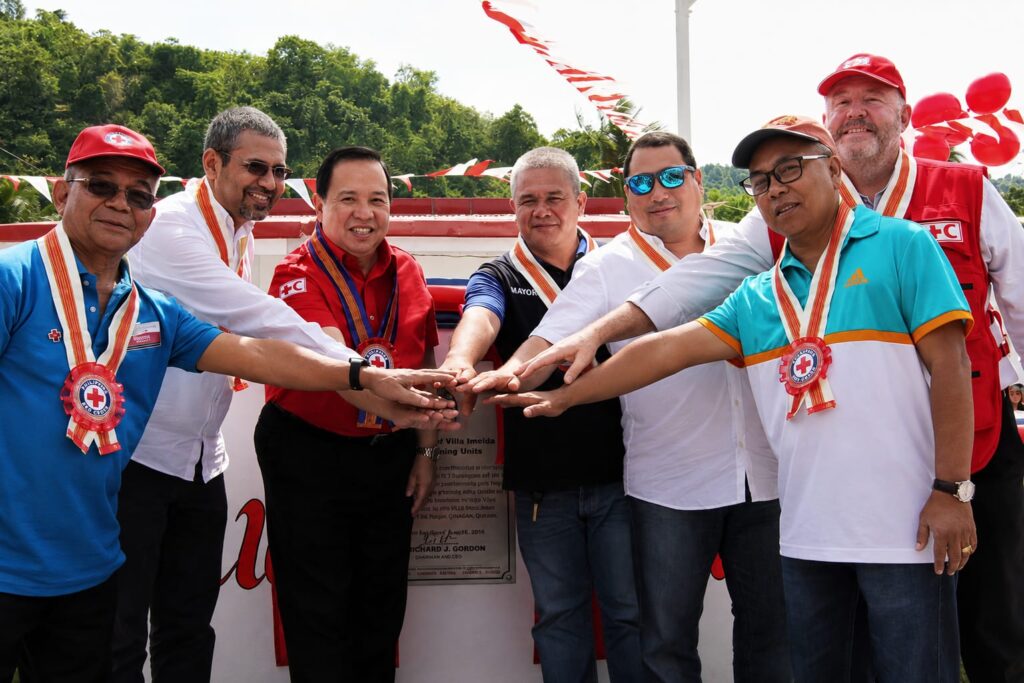
In 2014, shortly after Typhoon Haiyan, I arrived in the Philippines to lead the Norwegian Red Cross recovery programme.
This time the challenge was very different.
Thousands of families needed homes, but corrugated galvanized iron roofing sheets were extremely difficult to obtain. Demand was enormous, supplies were limited, and many organizations were waiting for materials before they could begin reconstruction.
Waiting was not a good solution for families who had already lost everything.
Through discussions with former ICRC friends, I learned that the ICRC had surplus roofing materials from an earlier procurement. I approached colleagues at different levels, eventually reaching the Head of Delegation, and proposed that the Norwegian Red Cross purchase the unused materials at full cost so we could begin reconstruction immediately.
It sounds straightforward when written today.
At the time, however, making it happen required something that could not be written into a procurement procedure.
A chain of trust.
My organization trusted my judgment.
The Philippine Red Cross trusted an alternative approach outside the usual procurement process.
The ICRC trusted our commitment and the proposed arrangement.
My team trusted the decision.
And I trusted my team’s ability to deliver.
Within weeks, construction was underway.
At the peak of the operation, our teams were building 70 houses every week. In less than nine months, we completed 1,233 permanent homes, while many recovery programmes were still struggling to secure the materials they needed to begin.
Looking back, I don’t believe that success was simply about procurement, logistics, or project management.
It was about trust. When organizations trust one another, when leaders trust their teams, and when teams trust each other, decisions can happen faster. Problems become shared challenges rather than institutional obstacles.
Trust did not simply support that operation.
It made the operation possible.
Trust Is an Organizational Culture
These experiences also taught me that trust does not exist only between two individuals.
It exists or fails to exist within organizations.
A supervisor who is trusted by senior leadership has greater confidence to empower the people below them. A manager who trusts the team gives people room to make decisions, take responsibility, innovate, and sometimes make mistakes.
That trust can continue down through an organization.
But the opposite is also true.
When people constantly have to protect themselves, seek approval for every decision, or worry that reasonable mistakes will be punished, leadership becomes cautious. Initiative disappears. Decisions slow down.
You can have excellent people inside an organization and still prevent them from performing if the culture does not trust them.
That is why I believe leadership is not only about earning trust from others.
It is also about creating an environment in which others are trusted.
Trust Yourself, Too
There is another form of trust that we sometimes forget.
Trust in ourselves.
This does not mean arrogance or believing that we are always right.
Quite the opposite.
Self-trust comes from knowing your profession, understanding your limitations, listening to people who know things you do not, and then having the courage to make a decision.
Humanitarian leaders rarely have perfect information.
Disasters do not wait for perfect assessments.
Conflicts do not wait for perfect security conditions.
Communities cannot always wait while organizations search for perfect certainty.
At some point, a leader has to decide.
You trust your experience.
You trust your principles.
You trust your organization.
You trust your team.
And then you act.
And Then You Start Again
Perhaps one of the strange realities of international humanitarian work is what happens next.
You arrive somewhere new.
Nobody knows you.
You listen.
You work.
You make mistakes.
You solve problems.
Slowly, people begin to trust you.
Your organization trusts you.
Your team trusts you.
Your National Society trusts you.
Partners trust you.
Communities recognize you.
Things begin moving almost naturally.
And then…
Your mission ends.
You pack your bags.
You move to another country.
Another organization.
Another culture.
Another team.
And you begin again.
Same person.
Same experience.
Zero trust.
Perhaps that is why, after more than three decades, I value trust so deeply.
Budgets matter.
Strategies matter.
Technical expertise matters.
Systems and procedures matter.
But without trust, none of them reaches its full potential.
People rarely trust leaders because of the titles they hold.
They trust leaders because, over time, their actions consistently match their words.
Trust is earned through humility.
Protected through integrity.
Strengthened through consistency.
And demonstrated through action.
It can take years to build and only moments to damage.
And perhaps the greatest responsibility of leadership is not simply to earn trust for ourselves, but to pass it on, to trust the people we lead enough that they, too, have the confidence and space to succeed.
Trust yourself. Trust your people. Earn the trust of others. And never take any of it for granted.
The reflections shared here are my own, shaped by experience in the field, and are offered in the hope that they contribute to learning, dialogue, and better humanitarian action.
Because experience has its greatest value when it is shared.